The images you'll see as you scroll down to the current text are all part of the story telling in my novel, Realms of Gold:Ritual to Romance.


Bianca Caldwell, pen name, Bianca Fiore, is a writer for an art magazine. In each of her monthly stories she describes an object used in ancient ritual.

Gold Lunula


The Gold lunula is a distinctive type of early Bronze Age necklace or collar shaped like a crescent moon.  

The gold lunula from the Gwithian area, Cornwall © The Trustees of the British Museum


They are normally flat and thin, with roundish spatulate terminals that are often twisted to 45 to 90 degrees from the plane of the body.

Of the more than a hundred gold lunulae known from Western Europe, more than eighty are from Ireland; it is possible they were all the work of a handful of expert goldsmiths, though the three groups are presumed to have had different creators. Several examples have a heavily crinkled appearance suggesting that they had been rolled up at some point.

Lunulae were probably replaced as neck ornaments firstly by gold torcs, found from the Irish Middle Bronze Age, and then in the Late Bronze Age by the spectacular gorgets of thin ribbed gold, some with round discs at the side, of which 9 examples survive, 7 in the National Museum of Ireland.


Gold lunula from Schulenburg, Germany, Provincial, linear group.


Gold lunula  - British Museum - Found in a bog on the Tir Dewin Farm

Flat sheet crescent of beaten gold with quadrangular terminals rotated relative to the crescent. It is decorated with an incised geometric pattern.

The horns are decorated with horizontal patterns of horizontal lines, rows of dots, bands of diamond shaped motifs and void spaces. The horn’s inner and outer edges are decorated with a border of horizontal lines.


A band of three incised lines and two irregular rows of dots separate the horns from the rest of the body.


The decoration extends down the body in the form of a border parallel with the inner and outer edges. The border consists of a series of parallel lines and rows of dots.


Gold lunula from Blessington, Ireland, Late Neolithic/Early Bronze Age, c. 2400BC – 2000BC, Classical group

Chevrons and Lozenges incised into the Blessington Lunula.

Incised or punched decoration, confined normally to the horns and the internal and external edges, usually consists of fields of simple geometric patterns, Zig Zags , lozenger , triangles , parallel lines.
 
Llanllyfni, Wales, Britain


Celtic Jewelry

A torc is an ancient Celtic form of neck ring. Although items from as early as 1800 BC have been found in Egypt that resemble torcs, the name is commonly used for bronze, iron or golden neck rings from the European Iron Age. These neck rings developed from simple rings into elaborately decorated ornaments with or without rich terminals. Most Celtic torcs have been found in France but there is an extremely wide spread of torc- like ornaments encountered throughout excavations from Spain to the British Isles and Scandinavia and from Persian lands to Egypt.


The Roman author Pliny writes that torcs were part of the Celtic battle-dress but excavations have revealed mainly women and girls wearing torcs. 


Celtic torc from the Iberian peninsula showing typical celtic chased motivs


Iron Age grave sites show us corpses that were fully dressed and ornamented. This allows us to form a detailed picture of jewelry worn in those days. The most widespread type of jewelry was the safety pin used to fix clothing: the fibula. Most commonly made from bronze but also found in iron, silver and gold this garment fastener is found in large numbers. Finger and toe rings were rare, more common were bronze and some gold and silver bracelets and cast bronze solid armlets, cast with the lost wax technique and decorated with enamel and glass. Red enamel in particular popular among the Celts. Torcs are another typical ornament found in Celtic graves, mainly female ones. This item developed from a plain iron ring to elaborately decorated neck rings in gold.


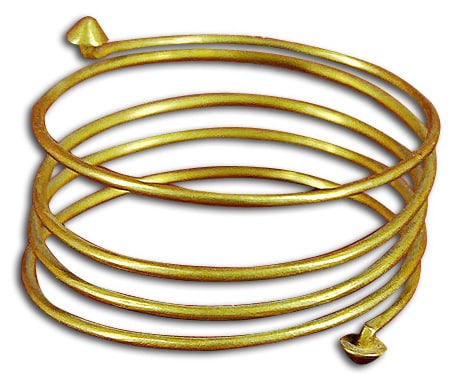
Golden Neck Ring 550BC.jpg

Roman influences are seen long before the Roman conquest of the Celtic lands but after the defeat of the Celtic armies in the first century BC and the Roman march to the Rhine and British isles had begun the full 'romanization' of the Celts was a fact. The Celtic 'high-society' started to act, dress and talk like Romans and the latest trends from the Empire's capital made it all the way up to Northern Europe. Finger rings, chain necklaces and earrings were new forms of jewelry in these parts of the world up until then and became popular items. New materials such as gemstones and silver were introduced as well. But it wasn't all new though, certain typical Celtic characteristics are still to be recognized in jewelry from the first quarter of the first millennium such as the use of enamel and typical Celtic knot motives. Old styles fused with new ones to produce a Gallo-roman style.


Celtic Spiral Bracelet.jpg

Read more


Celtic Gold

The Frasnes-lez-Buissenal pot-hoard found near a spring in Belgium. Dated 50 B.C. the hoard, which consisted of two gold torcs and nine gold coins, was probably a ritual offering to a spring deity worshiped because the two gold torcs were not designed to be worn by its Nervii tribal owners.


The ancient Greek writer, Diodorus, writing circa. 20 B.C. commented about the astonishing Celtic religious practice of safely and freely depositing gold offerings such as the Frasnes-lez-Buissenal hoard in temples and other sacred sites.


 Nervii tribal hoard

Although no provenance is provided for this Celtic gold ring, it is dated to 400-300 B.C. (early La Tene period). Part of a trio of gold rings, the ring has a ram's head motif similar to the gold torc found in the Nervii tribal hoard. The Nervii were one of the most powerful Belgic tribes; living in northern Gaul at the time of its conquest by Rome.


Again, sadly this iron/copper alloy sword and scabbard has no provenance. Dated late La Tene period at 60 B.C. the museum believes that the hilt depicts a warrior; however, ther figure is just as likely to depict a deity.


Broighter Hoard


A hoard of gold artefacts from the Iron Age of the 1st century BC that were found in 1896 by Tom Nicholl and James Morrow on farmland near Limavady, Northern Ireland.[2] The hoard includes a 7-inch-long (18 cm) gold boat, a gold torc and bowl and some other jewellery.


 Broighter Collar (c.100-50 BCE)

The luxuriously ornamented Broighter gold collar (torc), along with the Petrie Crown, is one of Ireland’s greatest surviving masterpieces of Celtic metalwork art from the Irish Iron Age.  Made by Irish metalworkers and goldsmiths during the first century BCE, the Broighter collar is a delicate tube of gold decorated in the La Tene style of Celtic art: a form influenced by Greek and Etruscan culture. Each end of the collar is buffer-shaped and fit together using a beautifully made T-shaped locking device.


The miniature boat is made out of sheet gold, a sheet gold bowl, two torcs made of twisted gold bars, two loop-in-loop gold chains with terminal boxes of sheet gold, and a large hollow torc made of hammered sheet gold highly decorated with incised and high relief swirls and arcs. The boat is obsessively detailed, complete with oars, benches, a rudder, yardarm and various tools.

Cross and bed found in Anglo-Saxon grave shed new light on 'dark ages'

The gold cross found in the grave of the young Anglo-Saxon woman. Photograph: Cambridge University


The dead are often described as sleeping, but archaeologists in Cambridgeshire have uncovered a bed on which the body of a young Anglo-Saxon woman has lain for more than 1,300 years, a regal gold and garnet cross on her breast.

Three more graves, of two younger women and an older person whose sex has not yet been identified, were found nearby.

Forensic work on the first woman's bones suggests she was about 16, with no obvious explanation for her early death. Although she was almost certainly a Christian, buried with the beautiful cross stitched into place on her gown, she was buried according to ancient pagan tradition with some treasured possessions including an iron knife and a chatelaine, a chain hanging from her belt, and some glass beads which were probably originally in a purse that has rotted away.
Pectoral crosses from the dawn of Christianity in England, and bed burials - where the body was laid on a real bed, now traced only by its iron supports, centuries after the timber rotted – are both extremely rare.
A gold and garnet pectoral cross of such quality, the most beautiful and sophisticated examples of Anglo-Saxon metalwork like the contemporary jewels found in the Staffordshire Hoard or the Sutton Hoo burial, could only have been owned by a member of an aristocratic or even royal family. Only five have been found, one in the coffin of St Cuthbert. In some contemporary pieces the gems came from as far as India, and the gold from melted down coins from Constantinople.

Treasures from Sutton Hoo: Sword Equipment

These few fragments are all that remain of a sword found at Sutton Hoo. A glass encasing has been used to reconstruct the sword hilt with the accessory fragments that remain. 

A large stone fragment can be seen here as the main portion of the hilt, with gold and garnet embellishments, most notably the pommel that sits at the top of the hilt. The sword was the most important weapon in Anglo-Saxon times, often traditionally passed down from father to son. Warriors who died in battle were even buried with their swords.


Gold and garnet-inlaid mounts from a sword harness. (Sutton Hoo)


Sword Handle
Garnet Buckle from a sword belt Sutton Hoo Ship Burial
Sutton Hoo Slider
The sword belt buckle shaped slider belt fastener from Sutton Hoo, made from gold with cloisonne and cabochon garnets and millefiori glass inlay.

Scabbard Bosses Found At Sutton Hoo


A pair of scabbard bosses found in the burial chamber at Sutton Hoo. A scabbard was a sheath for holding a sword, typically worn around the waist - bosses such as these were used to attach the scabbard to the sword belt at the top. The scabbard of a man of wealth would have been adorned with rich decoration. Like many other artifacts found at Sutton Hoo, these scabbard bosses display rich craftsmanship that reflected the high status and wealth of their owner. The bosses exhibit the same intricate inlay of garnet and gold.

Sutton Hoo Sword pyramids.

A set of small (18x12mm) pyramid fittings associated with the Sutton Hoo sword. Garnet cloisonne in gold, about 600AD. The Sutton Hoo pyramids are a miracle of cryptic stone setting, and they’re still holding fast to their secrets after 1400 years in the dirt.”

The Sutton Hoo sword fittings. Photographs courtesy Lindsay Kerr.

Strap distributor of gold, set with cloisonne garnets. It was designed to link two straps--the sword belt and a narrower strap that drops to the scabbard. The distributor is hinged beneath the horizontal mount and has a further mount that pendulates upon the hinged mount.


Hanging bowl from the Sutton Hoo ship burial


Early medieval Celtic, late 6th–early 7th century AD
From Mound 1, Sutton Hoo, Suffolk, England


This magnificent copper alloy hanging bowl is the largest of three found in the Sutton Hoo ship burial. It is an import from British peoples living beyond the Anglo-Saxon heartlands and was perhaps acquired as tribute or through a marriage alliance. Its discovery among other exotic imports confirms that it was highly valued. The bowl was in Anglo-Saxon hands for some time before it was buried, because it was repaired using silver patches decorated in with Anglo-Saxon style animals.
Hanging bowls were designed to be hung by hooked mounts from three or four rings fixed to the rim. This bowl, made of thin copper alloy sheet, has elaborately ornamented and inlaid hook-mounts, with extra ornamental square mounts in between. There is a further disc-shaped mount under the base and inside, uniquely, a free-standing copper alloy fish that could rotate. The mounts are decorated with red, blue and pale green enamel and brightly patterned millefiori glass. The curving lines and abstract patterns are typical of early medieval Celtic art from Britain and Ireland and it has been argued that this bowl was made in Ireland.

The silvery (tinned) fish ‘swimming’ inside is a clue to the bowl’s original use. It may have held water for hand-washing after a feast, or perhaps something stronger for drinking.
This is the decoration on another bowl from Sutton Hoo