Golden neck rings from Ålleberg, Sweden. Dates to the Migration period. On display at The Swedish Museum of National Antiquities.
The images you'll see as you scroll down to the current text are all part of the story telling in my novel, Realms of Gold:Ritual to Romance.
Bianca Caldwell, pen name, Bianca Fiore, is a writer for an art magazine. In each of her monthly stories she describes an object used in ancient ritual.
Viking Gold Neck Rings
Golden neck rings from Ålleberg, Sweden. Dates to the Migration period. On display at The Swedish Museum of National Antiquities.
Harrogate Hoard: Viking Gold
A reminder of our Viking past was recently discovered lurking beneath a Yorkshire field; what is now being called the ‘Harrogate Hoard’ is an archaeological find of global significance. Said by experts to be the most important Viking find in Britain in 150 years, the finders, metal detectorists David and Andrew Whelan, called the discovery a ‘thing of dreams’.
The hoard consists of 617 silver coins and 65 other items, including ornaments, ingots and precious metal, which were hidden in a gilt silver vessel lined with gold (variously identified as a cup, bowl, or pot) made in France or Germany around 900 and decorated with "vines, leaves and six hunting scenes showing lions, stags, and a horse". The lions were lionesses, with no mane. The vessel is thought to have been used to hold communion bread for a wealthy church or monastery in northern France and to have been acquired either in a Viking raid or as tribute.
![]() |
| The hoard was found by father and son David and Andrew Whelan while metal detecting near Harrogate in 2007. David described the find as a "ball covered with mud". Picture: British Museum Trustees. |
![]() |
| Some 100 of the 617 coins in the hoard have now been cleaned. Conservators are delighted with their condition. Picture: British Museum Trustees. |
The hoard consists of 617 silver coins and 65 other items, including ornaments, ingots and precious metal, which were hidden in a gilt silver vessel lined with gold (variously identified as a cup, bowl, or pot) made in France or Germany around 900 and decorated with "vines, leaves and six hunting scenes showing lions, stags, and a horse". The lions were lionesses, with no mane. The vessel is thought to have been used to hold communion bread for a wealthy church or monastery in northern France and to have been acquired either in a Viking raid or as tribute.
Viking Gold
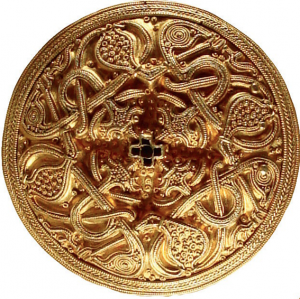
Viking gold brooch from Hedeby, Germany
Neck-ring (10th century, Kalmergården, Tissø, Zealand, Denmark). Gold© The National Museum of Denmark
Hiddensee Treasure: Viking Gold
One of the most stunning but lesser known archaeological finds in Germany is the 'Gold Jewellery of Hiddensee', which was discovered by chance in the 19th century on the tiny island in the Baltic. Since their discovery, the sixteen items in the hoard dating from the Viking Age have been presided over by the Kulturhistorisches Museum of the Hanseatic town of Stralsund.
All items of jewellery, including a brooch (fibula), a neck ring and 14 pendants are of pure gold and weigh some 600 g altogether. It is likely the jewellery originally belonged to the family of the Danish King, Harald Gormsson (died ca. 980), better known by his nickname, 'Bluetooth'.
Cross Motif
Undisputed is the connection with the „Viking" animal symbolism. The animal head in the centre could be the head of an eagle or an owl. However, some scientists speak of Greek-Byzantine influences; others see an astonishing similarity to the hammer form of the God Thor (from the northern mythology).
Fibula Motif
The cross in the centre can be evaluated as a Christian symbol. The Viking goldsmith art shows us finest intertwined gold wires, tender rosettes and tiny up-strewn balls of the gold granule. With some imagination one can see snakes with artfully entwined bodies. It could also be four dragon heads facing each other, whose bodies end in two-toed claws.
Neuendorf/Hiddensee, Rügen, Germany. Gold © Jutta Grudziecki, Kulturhistorisches Museum der Hansestadt Stralsund
The Staffordshire Hoard: Biblical Inscription
"Rise up O Lord, and may thy enemies be dispersed and those who hate
thee," reads the Latin inscription on this strip of gold--a fitting bit
of Bible verse for a war-torn place and time, Britain in the Dark Ages
(roughly A.D. 500 to 1000).
The silver gilt strip bearing a Biblical inscription in Latin is one of the most significant and controversial finds in the Staffordshire Hoard.
Rivet holes show that it was originally fastened to another, larger object. We are not yet sure what this was, but it might have been something like a reliquary or the cover of a Bible. A decorative stone, possibly a garnet, was set into the now empty mount at one end of the strip, whilst an animal head adorns the other end.
Incised into each face of the strip is a verse from the Latin Bible (Numbers 10:35). The text is slightly different on the two sides, but it is clear that the outer side is the most important one since the incisions for the letters have been filled with a dark, silver compound known as niello. There are two spelling mistakes in the Latin.
This suitably warlike outer inscription reads (mis-spellings bolded and underlined):
'Surge domine et disepentur inimici tui et fugent qui oderunt te a facie tua'
The text should read:
'Surge domine et dissipentur inimici tui et fugiant qui oderunt te a facie tua'
When translated, the inscription reads “rise up, o Lord, and may thy enemies be scattered and those who hate thee be driven from thy face”.
Michelle Brown, Professor of Medieval Manuscript Studies, has suggested the style of lettering dates from the seventh or early eighth centuries. The relatively crude lettering may have been the work of someone more used to writing on wax tablets.
The Staffordshire Hoard: Mystery Object
Conservators have discovered that three gold, garnet and enamel pieces from the Staffordshire Hoard which bore no immediately obvious relation to each other fit together to form a beautifully perplexing mystery object.
The millefiori stud, a gold mount with a collar of garnets and a glass enameled checkerboard surface, has a rectangular hole on the under side surrounded by four smaller round holes. A small gold cylinder decorated with cloisonné garnets has a rectangular protuberance of silver on one end and four round holes. The cylinder’s tab A fits into the millefiori’s slot B perfectly, and the four holes on both pieces align.
On the bottom end, the cylinder has another set of four matching holes with a torn piece of silver plate in the center. That torn plate in turn matches precisely the torn silver in the center of an elaborate gold cloisonné garnet circular object . The silver plate in the middle was riveted to the gold circle by four rivets, same as the holes on the other two pieces. Those four rivet holes show up on the other side of of the circular object, too, so our mystery object has at least one more part.
(Aesopian interlude: as historian David Starkey noted at the time, this is why it’s so important to keep archaeological discoveries intact in their proper context. If the hoard had been broken up and sold to the highest bidder, those pieces could have been scattered to the four corners of the earth.)
As for what it might have been used for, researchers have proposed several possibilities.
The Staffordshire Hoard: Gold and Garnet Objects
Gold and garnet bird of prey from the Staffordshire Hoard
The Staffordshire Hoard: Gold and garnet sword pyramid with figures of birds.
Closeup of garnet object from Staffordshire Hoard showing foil backing
Gold zoomorphic mount
Subscribe to:
Posts (Atom)