The images you'll see as you scroll down to the current text are all part of the story telling in my novel, Realms of Gold:Ritual to Romance.


Bianca Caldwell, pen name, Bianca Fiore, is a writer for an art magazine. In each of her monthly stories she describes an object used in ancient ritual.

Purse lid from the Sutton Hoo

Wealth, and its public display, was probably used to establish status in early Anglo-Saxon society much as it is today. The purse lid from Sutton Hoo is the richest of its kind yet found.


Anglo-Saxon, early 7th century AD
From Mound 1, Sutton Hoo, Suffolk, England
British Museum

The lid was made to cover a leather pouch containing gold coins. It hung by three hinged straps from the waist belt, and was fastened by a gold buckle. The lid had totally decayed but was probably made of whalebone – a precious material in early Anglo-Saxon England. Seven gold, garnet cloisonné and millefiori glass plaques were set into it. These are made with a combination of very large garnets and small ones, deliberately used to pick out details of the imagery. This combination could link the purse-lid and the fine shoulder clasps, which were also found in the ship burial, to the workshop of a single master-craftsman. It is possible that he made the entire suite of gold and garnet fittings discovered in Mound 1 as a single commission.
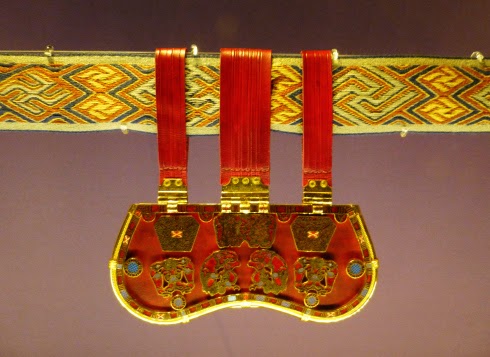

Replica reconstruction of the purse-lid in the Sutton Hoo Museum, Sutton Hoo

The plaques include twinned images of a bird-of-prey swooping on a duck-like bird, and a man standing heroically between two beasts. These images must have had deep significance for the Anglo-Saxons, but it is impossible for us to interpret them. The fierce creatures are perhaps a powerful evocation of strength and courage, qualities that a successful leader of men must possess. Strikingly similar images of a man between beasts are known from Scandinavia.

Treasures of Sutton Hoo: The Great Gold Buckle


The "great" gold buckle is made in three parts. The plate is a long ovoid of a meandering but symmetrical outline with densely interwoven and interpenetrating ribbon animals rendered in chip-carving on the front. The gold surfaces are punched to receive niello detail. The plate is hollow and has a hinged back, forming a secret chamber, possibly for a relic. Both the tongue-plate and hoop are solid, ornamented, and expertly engineered.

Treasures from Sutton Hoo: Shoulder clasp


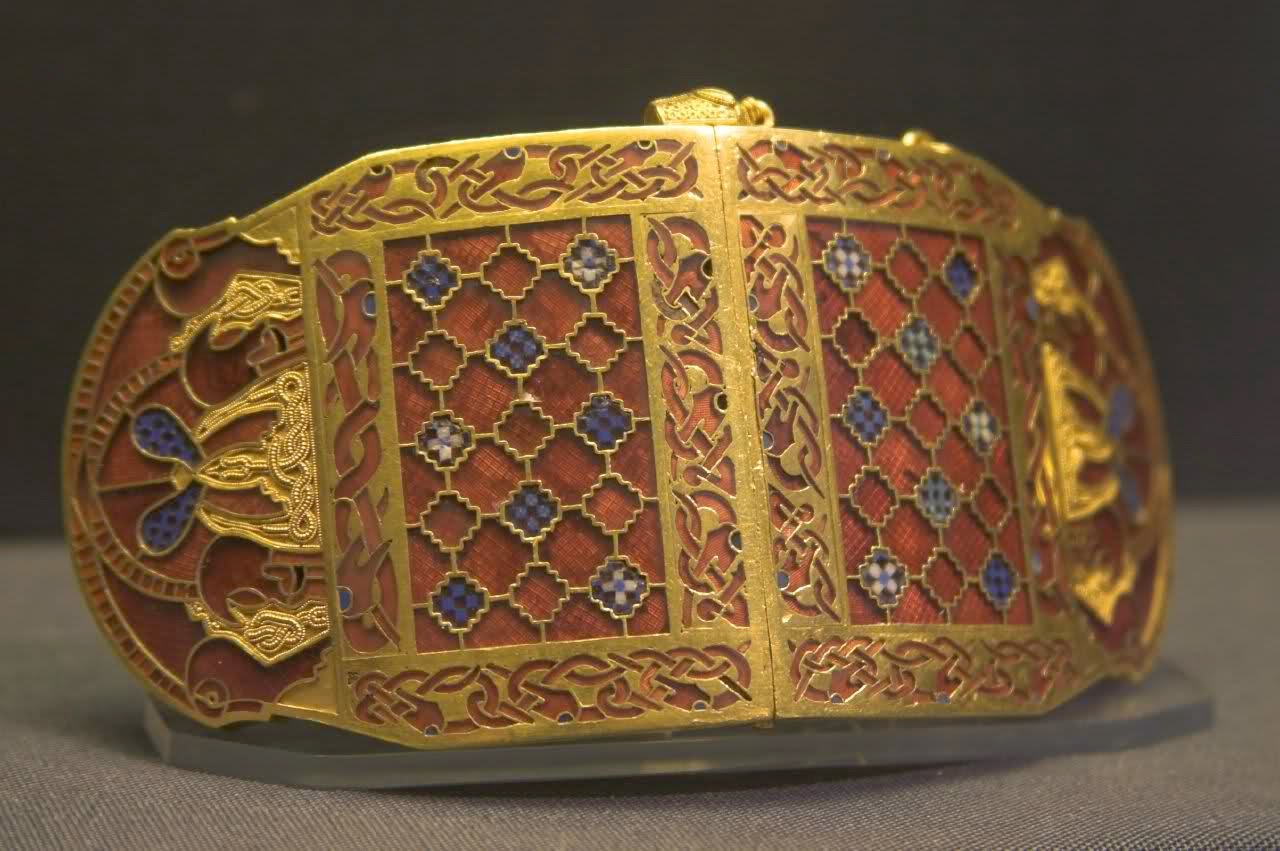
 Shoulder Clasp - to hold a cape together


The undisturbed grave goods were buried in a huge clinker-built ship some eighty feet long with provision for forty oarsmen. The ship and its contents were buried under a large mound of earth in a royal cemetery containing at least eighteen other mounds of various sizes. The astonishing treasure of 'royal regalia', weaponry, and objects of everyday use gives an important insight into Anglo-Saxon life at the beginning of the 7th Century. If it had not been for Sutton Hoo we would not be able to realise the incredible wealth, power, influence and connections of 7th Century kings in England.

Treasures of Sutton Hoo: Burial Ship


Archaeologists work at the Sutton Hoo site: Painstaking excavations of the burial ship led to the rewriting of Anglo-Saxon history as it emerged that craftsmen from the era were much more advanced than thought

The original length of the largest boat-burial mound at Sutton Hoo was significantly reduced as a result of extensive ploughing over the centuries, and reduced even further when a medieval trackway cut through the site. Archaeological evidence revealed that the 17th century robbers had actually tunneled into the mound on several occasions into what they believed was the center of the mound, though amazingly enough – they had missed the tomb altogether due to the rather (but fortunately for us and history) dramatic alteration in both the size and shape of the mound.

 
Gold Roman Solidus coin of Julius Nepus 473 - 5 AD from Sutton Hoo.

Treasures from Sutton Hoo: Raedwald Helmet

Around 624 or 625, Raedwald, the High King of the East Angles, must have died, although we have no written evidence for this. After the battle on the River Idle, Bede gives Raedwald no further space.

Raedwald was the greatest of the Wuffinga kings, and it is generally accepted that he was buried in a pagan ship burial at Sutton Hoo, in great splendour.

 
This ceremonial helmet is one of the most important finds from Sutton Hoo.


Replica of the helmet from the Sutton Hoo


During the early 1930's Edith Pretty a landowner in Suffolk reported that she had seen ghostlike figures of Saxon warriors dancing on mounds near her home. She was so taken aback by her supernatural encounter (which she believed to be an ‘omen’ or ‘sign’) she decided to sponsor a thorough archaeological investigation of the area.

In May 1939 Basil Brown the leading archaeologist from Ipswich Corporation Museum and his team were authorized to carry out the work on mound one.

What followed next as a result of these excavations was the discovery of the Sutton Hoo ship burial containing many precious items of outstanding beauty and craftsmanship. This collection of priceless Anglo-Saxon artifacts has become Britain’s favorite national treasure.


SUTTON HOO SHIELD
 The shield-fittings reassembled

Treasures from Sutton Hoo

 
Burial chamber of the Sutton Hoo ship-burial 1, England. Reconstruction


Sutton Hoo is one of England’s most significant archaeological sites. The 30-metre long ship was found buried undisturbed under one of many mysterious mounds at the site. It was found to contain a burial chamber housing a rich collection of finds.

As well as the purse lid the finds included helmets, spears, a sword, lyre and drinking horns. A set of shoulder clasps match the workmanship of the purse lid and were probably made by the same craftsman.


Although no body was found it is likely to be the burial site of King Raedwald, who ruled from around 599-624 AD and is credited as being one of the first English leaders to be converted to Christianity.

The finds changed the way historians thought about Anglo-Saxon society and showed it to be more advanced than previously thought.

 
A collection of rare 7th century gold Merovingian coin issues from the Sutton Hoo king's purse, most examples in this collection were produced at different Frankish mints.