The images you'll see as you scroll down to the current text are all part of the story telling in my novel, Realms of Gold:Ritual to Romance.


Bianca Caldwell, pen name, Bianca Fiore, is a writer for an art magazine. In each of her monthly stories she describes an object used in ancient ritual.

The Regolini-Galassi Tomb - Etruscan Gold


In 1836 the archaeologists Archbishop Alessandro Regolini and General Vincenzo Galassi uncovered an intact tomb of a high-ranking Etruscan womanIn the western necropolis of Cerveteri, in the village of Sorbo. Following the discovery of the tomb’s spectacular treasures, which included hundreds of pieces of jewelry, all things Etruscan became fashionable in Europe. Italian goldsmiths, masters in the techniques of granulation and filigree work, developed neo-Etruscan style jewelry.

Golden disc fibula from the Regolini-Galassi tomb, 7th century BC (photo: Vatican Museum)

This grand gold fibula adorned with five tiny lions depicted striding across its surface, and a large 25 cm long plaque, decorated with depictions of animals of Eastern origin was one of the many gold items found in the tomb.The fibula has been acclaimed as masterful in technique.


Together with the fibula, this breastplate was worn by the deceased woman in the end cell who thus appeared to the amazed discoverers as literally covered in gold.

It consists of a single laminated sheet shaped and decorated with embossed work with a series of 16 different punches. The decoration is divided into strips that follow the margins, going around the central emblem, and are characterized by the serial repetition of the same motif. Starting from the outer strip we see the following series of illustrations: broken line; grazing male ibex; winged lion; chimera with two protomes; pegasus; rear view of lion; grazing deer; woman in a tunic with a palm frond; winged lion, winged woman, lion. In the central emblem: semicircular decorations with overlapping spirals and stems, winged lions, women with palms and four male figures, each holding the front paws of a pair of rampant lions.


Four of the eighteen fibulae from the Regolini-Galassi Tomb tomb that were probably used to fasten the shroud.


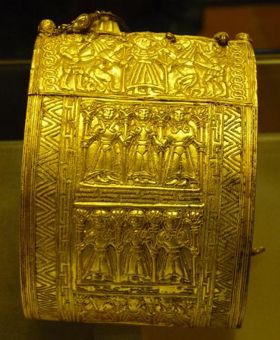
The arm bands came from the Regolini-Galassi tomb at Cerveteri. They were manufactured in the middle of the 7th century B.C., in the local area; each bracelet is made of a rectangular band of gold.

The central part of each bracelet is decorated with repeated scenes of three standing female figures, who hold a palm in each hand.

At each end, the bands are decorated with a more complex scene: two palms surround a woman who stands between two lions, each stretching out a front paw and leaning the other on her shoulder.


Embossed and engraved gilt silver cup, from Regolini Galassi tomb at Cerveteri (Rome)

Gold Earring Stud 530–480 BC

Gary Kurtz, Producer of Star Wars, Comments on Dennis Stanfill

Gary Kurtz and George Lucas on the set of Star Wars

"Eventually the Fox board decided they wanted to see a rough cut of the movie — at the worst possible time.

The board [including Princess Grace of Monaco] came to the mix one night. We could only work at night because the mixing theater was busy during the day. We were supposed to mix at Warner Brothers and their big stage, and we got preempted by Clint Eastwood and his film [The Gauntlet]; he was a much bigger name at Warner Brothers than we were. Goldwyn didn’t have any time either, but the head of Goldwyn said, “Well, I could let you work at night, and we’ll pull in another crew.” So, we worked from 8 p.m. to 8 a.m. every day.

The board came in when we were just finishing up the [very unusual at the time] Dolby stereo mix. They came at the beginning of our session, at 8 p.m. I don’t think we had any titles then. No end titles or anything.

The board sat there and watched the film, and at the end they got up and left, not a word. No applause, not even a smile. They just got up and left. We were really depressed. Stanfill came up to me right at the very end, he was the last one to leave. He said, “Don’t worry about them. They don’t know anything about movies.”

Terry Stanfill, Princess Grace, Dennis Stanfill

Terry Stanfill comments: "We remember the Sunday night Dennis called us into his office when he signed the go-ahead payment to begin Star Wars.  Francesca has what we still call the :Star Wars desk.  He thought it was important enough to call us in to watch--but who could have possibly imagined that it would have come to this!"


Read More at Mashable 


Tesoro de Villena


In 1963, in the Spanish town  of Villena  a, jeweler  admired a similar bracelet on the arm of  on a young gypsy woman , When he examined the heavy cuff  more closely, he saw that it was pure solid and heavy gold, weighing a pound.  He summoned the director of Villena’s museum of archaeology, Jose Maria Soler to investigate.  The woman told him that her husband had found it in a pile of sand being used to mix concrete. A month later another gypsy woman was seen wearing a similar bracelet.

She insisted it was a family treasure but when Soler examined her ”heirloom” he saw that like the other bracelet, it bore fresh traces of soil. Believing the gypsies had accidentally uncovered a prehistoric find, the archaeologist obtained legal permission to confiscate both pieces until their origin could be determined. Soon after, the husband of the second gypsy, confessed he had found both while working a gravel quarry and volunteered to help the archaeologists.

Soler and his team began to dig—but no luck.  One day, when they were about to give up for the day,  one of the men discovered yet  another heavy gold bracelet which was soon followed by a huge pottery jar filled to the brim with gold.


An  inventory of the jar revealed an impressive haul: sixty eight separate pieces including five flagons, twenty-eight bracelets and two sword handles. The total weight of the gold treasure was over twenty-two pounds, the heaviest yet unearthed. One bracelet alone weighed more than a pound. The jar had been so skillfully packed that not an inch of space was wasted. This fact, plus the great depth suggests that it was a king’s treasure which had been buried for safekeeping. Evidence of fire in the soil around the spot indicated that a building once stood there, perhaps a royal palace which was set ablaze in the course of a battle.


The question is, what king? Soler theorized it was one of the petty rulers in southern Spain during the late Bronze Age and that, like other kings, he had his own private army and goldsmith According to Homer, Mycenaean kings (of the same period) ate from dishes of silver and gold.  The golden bowls and flagons were probably royal tableware.


Christie’s London May, 2013 This magnificent Celto-Iberian bracelet estimated at $60,000-90,000 was the star lot, selling for ten times estimate at $804,780! 


Found in Portalegre in Portugal, it is probably the only example of its type still in private hands. A similar piece was found in nearby Estremoz and  is now in the National Museum of Madrid. This type of bracelet reflects  the technological changes that occurred at the beginning of the Iron Age, -Tools made: new, high-temperature furnaces designed for iron production made it easier to melt large amounts of gold, and tools made of iron were sharper, more precise, and more durable than those of copper alloy with the new and sharper iron tools.


Treasure of Villena

The Treasure of Villena (in Spanish Tesoro de Villena) is one of the greatest hoard finds of gold of the European Bronze Age. It comprises 59 objects made of gold, silver, iron and amber with a total weight of almost 10 kilos, 9 of them of 23.5 carat gold. This makes it the most important find of prehistoric gold in the Iberian Peninsula and second in Europe, just behind that from the Royal Graves in Mycenae, Greece.

The iron pieces are the oldest found in the Iberian Peninsula and correspond to a stage in which iron was considered to be a precious metal, and so was hoarded. The gold pieces include eleven bowls, three bottles and 28 bracelets.

The hoard was found in December 1963 by archaeologist José María Soler 5 km from Villena, and since then has been the main attraction of Villena's Archaeological Museum. Its discovery was published in most of the Spanish media and also some abroad, mainly in France, Germany and the United States of America. It has been exhibited in Madrid, Alicante, Tokyo and Kyoto, and now there are two sets of copies of the whole treasure to be shown in exhibitions while the originals are permanently conserved in an armoured showcase at Villena's Archaeological Museum.


Long Hidden Scythian Treasure Site Located at Ceremonial Spring in Poland


A farmer made an amazing discovery more than 130 years ago in a field outside Vettersfelde (now Witaszkowo) Poland. He stumbled upon a great hoard of golden treasure, including dozens of ornaments dating back to the sixth century. But the precise location of the cache was forgotten and unknown to archaeologists until modern excavations revealed the site of the Vettersfelde Treasure.
golden object made up of four disks, each decorated with animals around a central boss, and a smaller central disk. It might have been part of a breast plate or a harness.

In 1882 the rich artifacts found by chance in the Province of Brandenburg were collected, and some now reside in Staatliche Museen’s Antikensammlung (Collection of Classical Antiquities) in Berlin. Archaeologists had been searching for the exact source of the discovery since World War II. However, it wasn’t until 2001 that investigations narrowed down and finally uncovered the exact location.


Above: Iron sword and sheath; the scabbard and the sword's hilt and pommel are covered with sheet electrum. The shape of the sword is unmistakably that of an akinakes, the typical Scythian sword. The lower half of the sheath, now lost, had an ornamental band of soldered gold wire, braided and beaded, that bordered double spirals;below this band was a pendent row of leaf-shaped loops. The upper part of the sheath is divided into four areas. The top has a nose and two cut-out eyes; the rounded bulge is decorated with a lion and a star rosette; the long narrow part is divided by a ridge into two fields; above, a leopard pursuing a boar, followed by a fish; below, a lion attacking a fallow deer, again followed by a fish. These animals resemble those on the big fish very closely.

As reported by Science and Scholarship in Poland (PAP), the hoard of animal-themed artifacts are presumed to be Scythian. The treasure weighed nearly 5 kilograms (11 pounds) and was comprised of many items, including; a fish-shaped plaque depicting a panther, board, lion, and deer; a dagger sheath detailed with fish, vultures and deer; animal-decorated golden discs thought to be part of a breast plate; pendants and jewelry; and a massive golden torc.

The Scythians were a nomadic people of Iranian descent who migrated from central Asia into southern Russia and eastern Europe. They founded a powerful empire in the region of what is now Crimea, and were well known for their skills in battle and their horsemanship.

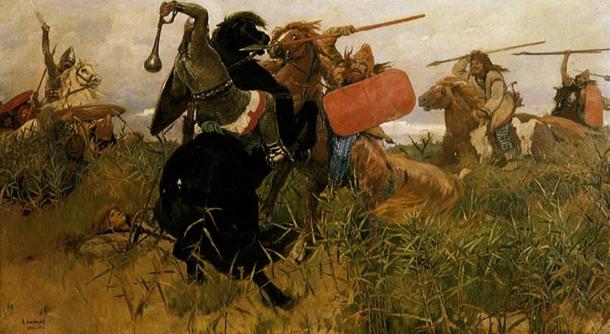
 Battle between the Scythians and the Slavs (Viktor Vasnetsov, 1881).

The joint study in Witaszkowo, held by several research and archaeological institutions and headed by by Professor Zbigniew Kobyliński and Dr. Louis Daniel Nebelsick, found success in the long search.

“By analyzing archival documents preserved in Berlin museums and field work, archaeologists identified the original place of the treasure discovery. It is a  field situated between the present villages Witaszkowo and Kozów,” reveals PAP.


Gold Scythian pectoral, or neckpiece, from a royal kurgan in Tolstaya Mogila, Ordzhonikidze, Ukraine, dated to the second half of the 4th century BC. The central lower tier shows three horses, each being torn apart by two griffins.

It is thought by researchers that the treasure represents items belonging to Scythian leaders who were killed while fighting the local people of the Lusatian culture, reports archaeology news site Past Horizons. However, the discovery of the hoard spurred a long scholarly debate as to why the artifacts were buried at the site, and by whom. 

Excavations at the site revealed a ceremonial spring which was lined with stones. The surrounding area was topped with paving stones and a burnt area. The remains of a wooden bridge were also discovered.
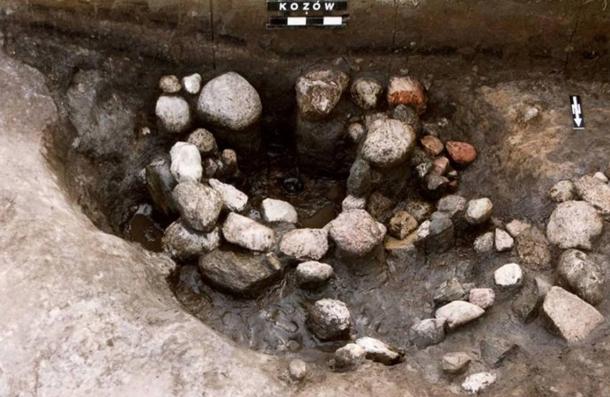
Ceremonial spring discovered during the excavations near Witaszkowo, Poland.
Ceremonial spring discovered during the excavations near Witaszkowo, Poland. Credit: Z. Kobyliński


Hundreds of bowls with omphalos (or navel-shaped indentations at the bottom) were found at the spring. They are said to be similar to ancient Greek ritual drinking vessels, of a type only found in Poland as funerary goods. The bowls were said to be filled with liquids and poured out as sacrifice to gods, and metallographic analysis of the gold artifacts showed they had been in fire, but were not used as everyday items.

Ancient Greek golden phiale, or vessel with omphalos seen in the center.


Archaeologists also recovered unique glass beads, thought to have been crafted on the Black Sea.

Kobyliński and colleagues have published the results of their research in the book ‘Finding and contextualizing of the Vettersfelde / Witaszkowo Hoard’.

In the publication, the researchers theorize that the Scythians offered the treasure to local chiefs as gifts. It is their belief that the gifts were diplomatic offerings: “the Scythians not only destroyed and looted, but also tried to secure control of long trade routes by establishing good relations with the local population,” writes Past Horizons.

Kobyliński says, “This discovery allowed us to reject previously prevailing belief that the Witaszkowo [Vettersfelde] Treasure was the spoils of war captured by the local population during battle with Scythians invaders, or a Scythian chieftain’s grave.”

The steppes art typical of the Scythians was intricate and decorative, and composed of gold, wood, silver, bronze, iron, leather and bone. Motifs were often very detailed animal and human figures. Pieces were kept light and portable to suit their largely nomadic lifestyles. Elaborate hoards of goods have been found at burial mounds and ceremonial sites across Central Asia, southern Russia and Europe, now including the Vettersfelde Treasure in Poland.

Examples of golden Scythian art. The treasure of Kul-Oba, Crimea, 400 to 350 BC. 

Scythian gold plaque with panther, probably for a shield or breast-plate, circa end 7th-century BC.

A successful conclusion to this enduring archaeological mystery is no doubt gratifying to the researchers and to those who appreciate learning more about the artisans, warriors and traders of the ancient past.

Reposted from Ancient Origins

Featured Image: Scythian Golden Fish from the Treasure of Vettersfelde circa 500 B.C.  Altes Museum, Berlin, Germany. © Staatliche Museen zu Berlin, Antikensammlung / Johannes Laurentius; CC NC-BY-SA

Merovignian Bees


To the Merovingians, the bee was a most hallowed creature. A sacred emblem of Egyptian royalty, it became a symbol of Wisdom. Some 300 small golden bees were founded stitched to the cloak of Childeric I (son of Meroveus) when his grave was unearthed in 1653.

Gold Disc with Bees, 700-600 BCE. Collection of Nasher Museum of Art at Duke University


The Merovignian Bees influenced Napoleon, who, looking for a heraldic symbol different from the fleur-de-lys, used them as an inspiration for his own personal symbol and were incorporated into the Coat of Arms of the new Napoleonic French empire. Napoleon had these attached to his own coronation robe in 1804. He claimed this right by virtue of his descent from James de Rohan-Stuardo, the natural son (legitimized in 1667) of Charles II Stuart of Britain by Marguerite, Duchesse de Rohan.

Napoleon's bee flag of Elba, also known as the bumblebee flag of Elba


The Stuarts in turn were entitled to this distinction because they, and their related Counts of Brittany, were descended from Clodion’s brother Fredemundus – thus (akin to the Merovingians) they were equally in descent from the Fisher Kings through Faramund. The Merovingian bee was adopted by the exiled Stuarts in Europe, and engraved bees are still to be seen on some Jacobite glassware.”


“ …the Merovingian kings, from their founder Merovee to Clovis (who converted to Christianity in 496) were ‘pagan kings of the cult of Diana’.” The bees, which are a recurring symbol of the Merovingians are, in the Typhonian Tradition, represented frequently as the humming or buzzing sound that occurs before the appearance of the Great Old Ones or “beings” proper to this tradition.


Gold Bees with red glass wings
The early Merovingians were fascinated by bees. The above gold pieces were discovered in the Merovignian tomb of Childeric I, the father of Clovis, in 1653 by a mason working on the reconstruction of the church of Saint-Brice in Tournai, were several gold items including 300 golden bees.


Read more at Temple of Theola and Sang Reality 

Ancient Bee Goddess

The bee, found in Ancient Near East and Aegean cultures, was believed to be the sacred insect that bridged the natural world to the underworld.

Gold plaques embossed with winged bee goddesses, perhaps the Thriai, found at Camiros Rhodes, dated to 7th century BCE (British Museum)
The bee was an emblem of Potnia, the Minoan-Mycenaean "Mistress", also referred to as "The Pure Mother Bee". Her priestesses received the name of "Melissa" ("bee"). In addition, priestesses worshiping Artemis and Demeter were called "Bees". Appearing in tomb decorations, Mycenaean tholos tombs were shaped as beehives. The Delphic priestess is often referred to as a bee, and Pindar notes that she remained "the Delphic bee" long after Apollo had usurped the ancient oracle and shrine.

Greek Bee Fibula, 4th century BC The bee, found in the artifacts of Ancient


"The Delphic priestess in historical times chewed a laurel leaf," Harrison noted, "but when she was a Bee surely she must have sought her inspiration in the honeycomb.

Minoan Golden Bee. In Crete the Bee Goddess was worshiped. The Priestesses would wear wings and dance about in worship of the Great Mother.

Gold signet ring found in a tomb at Isopata, in the vicinity of Knossos. On the bezel is a representation of ecstatic ritual dance ceremony of adoration by women standing in a field of crocuses. They and the goddess appear to have the heads of bees. The smaller figure is considered to be a goddess descending from the sky. On the ground, the signs of an eye and snakes can also be seen. LM II period (15th century B.C.).