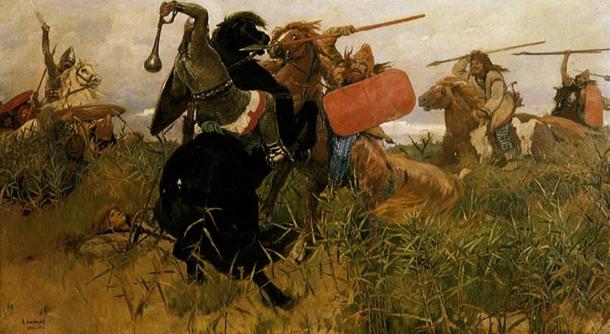
The images you'll see as you scroll down to the current text are all part of the story telling in my novel, Realms of Gold:Ritual to Romance.
Bianca Caldwell, pen name, Bianca Fiore, is a writer for an art magazine. In each of her monthly stories she describes an object used in ancient ritual.
Showing posts with label Artifacts. Show all posts
Did the Mayans Fly Airplanes?
Another great mystery that has caused many researchers to scratch their heads, are a group of 1,000-year-old gold pendants which have been unearthed within the Mayan ruins. These pendants measure just 150mm x 125mm in dimension, but they resemble objects that look almost exactly like modern-day airplanes. Some people debate the possibilities that these pendants are actually supposed to be flying insects or animals, but others bring up evidence that seems to prove that this is not the case. Airplanes, you see, require a part called a “vertical stabilizer”, which all of these pendants happen to feature, yet not a single animal on earth possesses. The question that remains is, “Could these aircraft actually fly?”
Read more
The Regolini-Galassi Tomb - Etruscan Gold
In 1836 the archaeologists Archbishop Alessandro Regolini and General Vincenzo Galassi uncovered an intact tomb of a high-ranking Etruscan womanIn the western necropolis of Cerveteri, in the village of Sorbo. Following the discovery of the tomb’s spectacular treasures, which included hundreds of pieces of jewelry, all things Etruscan became fashionable in Europe. Italian goldsmiths, masters in the techniques of granulation and filigree work, developed neo-Etruscan style jewelry.
![]() |
| Golden disc fibula from the Regolini-Galassi tomb, 7th century BC (photo: Vatican Museum) |
This grand gold fibula adorned with five tiny lions depicted striding across its surface, and a large 25 cm long plaque, decorated with depictions of animals of Eastern origin was one of the many gold items found in the tomb.The fibula has been acclaimed as masterful in technique.
Together with the fibula, this breastplate was worn by the deceased woman in the end cell who thus appeared to the amazed discoverers as literally covered in gold.
It consists of a single laminated sheet shaped and decorated with embossed work with a series of 16 different punches. The decoration is divided into strips that follow the margins, going around the central emblem, and are characterized by the serial repetition of the same motif. Starting from the outer strip we see the following series of illustrations: broken line; grazing male ibex; winged lion; chimera with two protomes; pegasus; rear view of lion; grazing deer; woman in a tunic with a palm frond; winged lion, winged woman, lion. In the central emblem: semicircular decorations with overlapping spirals and stems, winged lions, women with palms and four male figures, each holding the front paws of a pair of rampant lions.

Four of the eighteen fibulae from the Regolini-Galassi Tomb tomb that were probably used to fasten the shroud.
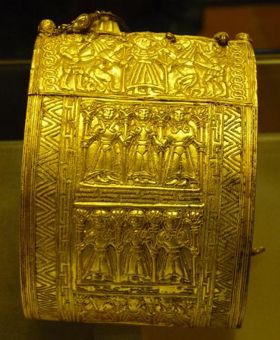
The arm bands came from the Regolini-Galassi tomb at Cerveteri. They were manufactured in the middle of the 7th century B.C., in the local area; each bracelet is made of a rectangular band of gold.
The central part of each bracelet is decorated with repeated scenes of three standing female figures, who hold a palm in each hand.
At each end, the bands are decorated with a more complex scene: two palms surround a woman who stands between two lions, each stretching out a front paw and leaning the other on her shoulder.
![]() |
| Embossed and engraved gilt silver cup, from Regolini Galassi tomb at Cerveteri (Rome) |
![]() |
| Gold Earring Stud 530–480 BC |
Long Hidden Scythian Treasure Site Located at Ceremonial Spring in Poland
A farmer made an amazing discovery more than 130 years ago in a field outside Vettersfelde (now Witaszkowo) Poland. He stumbled upon a great hoard of golden treasure, including dozens of ornaments dating back to the sixth century. But the precise location of the cache was forgotten and unknown to archaeologists until modern excavations revealed the site of the Vettersfelde Treasure.
![]() |
| golden object made up of four disks, each decorated with animals around a central boss, and a smaller central disk. It might have been part of a breast plate or a harness. |
In 1882 the rich artifacts found by chance in the Province of Brandenburg were collected, and some now reside in Staatliche Museen’s Antikensammlung (Collection of Classical Antiquities) in Berlin. Archaeologists had been searching for the exact source of the discovery since World War II. However, it wasn’t until 2001 that investigations narrowed down and finally uncovered the exact location.
Above: Iron sword and sheath; the scabbard and the sword's hilt and pommel are covered with sheet electrum. The shape of the sword is unmistakably that of an akinakes, the typical Scythian sword. The lower half of the sheath, now lost, had an ornamental band of soldered gold wire, braided and beaded, that bordered double spirals;below this band was a pendent row of leaf-shaped loops. The upper part of the sheath is divided into four areas. The top has a nose and two cut-out eyes; the rounded bulge is decorated with a lion and a star rosette; the long narrow part is divided by a ridge into two fields; above, a leopard pursuing a boar, followed by a fish; below, a lion attacking a fallow deer, again followed by a fish. These animals resemble those on the big fish very closely.
As reported by Science and Scholarship in Poland (PAP), the hoard of animal-themed artifacts are presumed to be Scythian. The treasure weighed nearly 5 kilograms (11 pounds) and was comprised of many items, including; a fish-shaped plaque depicting a panther, board, lion, and deer; a dagger sheath detailed with fish, vultures and deer; animal-decorated golden discs thought to be part of a breast plate; pendants and jewelry; and a massive golden torc.
The Scythians were a nomadic people of Iranian descent who migrated from central Asia into southern Russia and eastern Europe. They founded a powerful empire in the region of what is now Crimea, and were well known for their skills in battle and their horsemanship.
The joint study in Witaszkowo, held by several research and archaeological institutions and headed by by Professor Zbigniew Kobyliński and Dr. Louis Daniel Nebelsick, found success in the long search.
“By analyzing archival documents preserved in Berlin museums and field work, archaeologists identified the original place of the treasure discovery. It is a field situated between the present villages Witaszkowo and Kozów,” reveals PAP.

Gold Scythian pectoral, or neckpiece, from a royal kurgan in Tolstaya Mogila, Ordzhonikidze, Ukraine, dated to the second half of the 4th century BC. The central lower tier shows three horses, each being torn apart by two griffins.
It is thought by researchers that the treasure represents items belonging to Scythian leaders who were killed while fighting the local people of the Lusatian culture, reports archaeology news site Past Horizons. However, the discovery of the hoard spurred a long scholarly debate as to why the artifacts were buried at the site, and by whom.
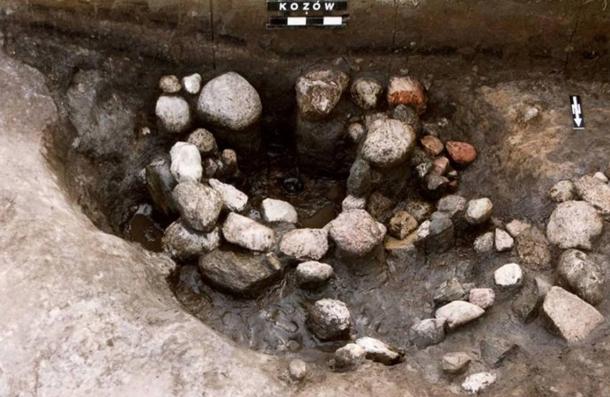
Excavations at the site revealed a ceremonial spring which was lined with stones. The surrounding area was topped with paving stones and a burnt area. The remains of a wooden bridge were also discovered.
![]() |
| Ceremonial spring discovered during the excavations near Witaszkowo, Poland. Credit: Z. Kobyliński |
Hundreds of bowls with omphalos (or navel-shaped indentations at the bottom) were found at the spring. They are said to be similar to ancient Greek ritual drinking vessels, of a type only found in Poland as funerary goods. The bowls were said to be filled with liquids and poured out as sacrifice to gods, and metallographic analysis of the gold artifacts showed they had been in fire, but were not used as everyday items.
![]() |
| Ancient Greek golden phiale, or vessel with omphalos seen in the center. |
Archaeologists also recovered unique glass beads, thought to have been crafted on the Black Sea.
Kobyliński and colleagues have published the results of their research in the book ‘Finding and contextualizing of the Vettersfelde / Witaszkowo Hoard’.
In the publication, the researchers theorize that the Scythians offered the treasure to local chiefs as gifts. It is their belief that the gifts were diplomatic offerings: “the Scythians not only destroyed and looted, but also tried to secure control of long trade routes by establishing good relations with the local population,” writes Past Horizons.
Kobyliński says, “This discovery allowed us to reject previously prevailing belief that the Witaszkowo [Vettersfelde] Treasure was the spoils of war captured by the local population during battle with Scythians invaders, or a Scythian chieftain’s grave.”
The steppes art typical of the Scythians was intricate and decorative, and composed of gold, wood, silver, bronze, iron, leather and bone. Motifs were often very detailed animal and human figures. Pieces were kept light and portable to suit their largely nomadic lifestyles. Elaborate hoards of goods have been found at burial mounds and ceremonial sites across Central Asia, southern Russia and Europe, now including the Vettersfelde Treasure in Poland.
![]() |
![]() |
| Scythian gold plaque with panther, probably for a shield or breast-plate, circa end 7th-century BC. |
A successful conclusion to this enduring archaeological mystery is no doubt gratifying to the researchers and to those who appreciate learning more about the artisans, warriors and traders of the ancient past.
Reposted from Ancient Origins
Featured Image: Scythian Golden Fish from the Treasure of Vettersfelde circa 500 B.C. Altes Museum, Berlin, Germany. © Staatliche Museen zu Berlin, Antikensammlung / Johannes Laurentius; CC NC-BY-SA
Dynasty of Priestesses
Greek archaeologists found an ancient skeleton covered with gold foil in a grave on the island of Crete. The woman, who presumably had a high social or religious status, was buried with a second skeleton in a large jar sealed with a stone slab weighing more than half a ton. It was hidden behind a false wall, to confuse grave robbers.
Excavator Nicholas Stampolidis said his team discovered more than 3,000 pieces of gold foil in the 7th-century B.C. twin grave near the ancient town of Eleutherna.
Female bust decorated with repoussé and granulation. The head characteristically features the so called Daedalic headpiece.On her chest are three nearly almond shaped vases and at the bottom four circled shaped "flowers."
Gold crescent shaped pendant decorated with granulation repoussé technique. Two male warrior heads with helmets vividly appear in heraldic profile. Between the helmets, a thick gold disk may have used a stone inset.
The grave also contained a copper bowl; pottery; perfume bottles imported from Egypt or Syria and Palestine; hundreds of amber, rock crystal and faience beads; as well as a gold pendant in the form of a bee goddess that probably was part of a rock crystal and gold necklace.
"If you look at it one way up, it's shaped like a lily," said Stampolidis, a professor of archaeology at the University of Crete who has worked at Eleutherna for the 25 years. "Turned upside down, you see a female figure holding her breasts, whose lower body is shaped as a bee with wings. The workmanship is exquisite."
Amid the jewels was a crescent lion god gold pendant. The lion is a beloved theme on the famous bronze shields of the Idaean Cave and in the necropolis of Eleutherna.
The ruins of Eleutherna stand on the northern foothills of Mount Ida -- the mythical birthplace of Zeus, chief of the ancient Greek gods. Past excavations have discovered a citadel, homes and an important cemetery with lavish female burials.
The town flourished from the 9th century B.C. -- the dark ages of Greek archaeology that followed the fall of Crete's great Minoan palatial culture -- and endured until the Middle Ages.
Read more
The Oxus Treasure
![]() |
| Assorted small objects from the Oxus treasure |
The Oxus treasure is the most important surviving collection of Achaemenid Persian metalwork. It consists of about 170 objects, dating mainly from the fifth and fourth centuries BC. This was the time of the Achaemenid empire, created by Cyrus the Great (559-530 BC), when Persian control stretched from Egypt and the Aegean to Afghanistan and the Indus Valley.
![]() |
The Treasure seems to have been gathered together over a long period, perhaps in a temple. It includes vessels, a gold scabbard, model chariots and figures, armlets, seals, finger-rings, miscellaneous personal objects, dedicatory plaques and coins It was found on the banks of the River Oxus, probably at the site of Takht-i Kuwad, a ferry station on the north bank of the river.
![]() |
| This is one of the earliest pieces in the treasure and is a scabbard for an akinakes, a short sword which is also shown on reliefs from Persepolis and on plaques within the treasure itself. |
The London group includes bowls, a gold jug, and a handle from a vase or ewer in the form of a leaping ibex, which is similar to a winged Achaemenid handle in the Louvre. No rhyton drinking vessels were found, but the British Museum has two other Achaemenid examples, one ending in a griffin's head similar to that on the bracelets in the treasure.
![]() |
| Gold jug and two bowls |
A hollow gold fish, apparently representing a species of carp found only in the Oxus, has a hole at its mouth and a loop for suspension; it may have contained oil or perfume, or hung as one of a group of pendants.
![]() |
| Gold Fish Vessel |
![]() |
| Gold model chariot |
In May 1880 Captain F.C. Burton, a British political officer in Afghanistan, rescued a group of merchants who had been captured by bandits while traveling between Kabul and Peshawar. They were carrying with them this rich collection of gold and silver objects. Burton bought from them a gold armlet, now in the Victoria and Albert Museum.
The two griffin-headed bracelets or armlets are the most spectacular pieces by far from the hoard and are typical of the 5th to 4th century BC court style of Achaemenid Persia. Bracelets of a similar form to ones from the treasure can be seen on reliefs from Persepolis being given as tribute, whilst Xenophon writes that armlets (among other things) were gifts of honor at the Persian court. Glass, enamel or semi-precious stone inlays within the bracelets' hollow spaces have now been lost.
| One of a pair of armlets from the Oxus Treasure, which has lost its inlays of precious stones or enamel |
Other pieces from the Treasure subsequently emerged in the bazaars of Rawalpindi. Some of those now in The British Museum were acquired by Major-General Sir Alexander Cunningham (1814-93), Director General of the Archaeological Survey of India, and others were obtained by Sir Augustus Wollaston Franks, who was both a curator in the Museum and a generous benefactor. In due course Franks bought Cunningham's share of the treasure, and eventually the entire Oxus treasure was bequeathed by him to The British Museum.
Sources: The British Museum, Wikipedia
The Varna Gold Treasure
Varna Man and the Wealthiest Grave of the 5th Millennium BC
In the 1970s, archaeologists in Bulgaria stumbled upon a vast Copper Age necropolis from the 5 th millennium BC containing the oldest golden artifacts ever discovered near the modern-day city of Varna. More than 300 graves were uncovered in the necropolis, and between them over 22,000 exquisite artifacts were recovered, including 3,000+ items made from gold.
Other precious relics found within the graves included copper, high-quality flint, stone tools, jewellery, shells of Mediterranean mollusks, pottery, obsidian blades, and beads.
Most people have heard of the great civilizations of Mesopotamia, Egypt and the Indus Valley, which are all noted for being the earliest known civilizations to feature urbanization, organized administration, and cultural innovation. But few have heard of the mysterious civilization that emerged on the shores of lakes of the Black Sea some 7,000 years ago in Bulgaria.
The Varna culture, as it has come to be known, was not a small and inconsequential society that emerged in a little corner of Bulgaria and disappeared quickly into the pages of history. Rather, it was an amazingly advanced civilization, more ancient than the empires of Mesopotamia and Egypt, and the first known culture to craft golden artifacts.
The Rise of the Varna Culture
Evidence suggests that it was between 4600 and 4200 BC, when gold smithing first started in Varna. As advances were made, and craftsmen mastered metallurgy of copper and gold, the inhabitants now had something extremely valuable to trade. Increased contacts with neighbours both north and south eventually opened up trade relations within the Black Sea and Mediterranean region, which was of great importance for the development of the society. The deep bay, along which the settlements of Varna, provided a comfortable harbor for ships sailing across the Black Sea and Varna became a prosperous trading center.
And so, the foundations had been laid for the emergence of a powerful and flourishing culture, whose influence permeated the whole of Europe for thousands of years to come.
Elite members of society were buried in shrouds with gold ornaments sewn into the cloth wrappings and their graves were laden with treasures, including gold ornaments, heavy copper axes, elegant finery, and richly decorated ceramics, while others had simple burials with few grave goods.
Grave36
Grave 43
While there were many elite burials uncovered, there was one in particular that stood out amongst the rest – grave 43. Inside grave 43, archaeologists uncovered the remains of a high status male who appears to have been a ruler/leader of some kind – more gold was found within this burial than in the entire rest of the world in that period. The male was buried with a scepter – a symbol of high rank or spiritual power – and wore a sheath of solid gold over his penis.
The burials in the Varna necropolis have also offered a lot more than the precious artifacts found within them and discoveries relating to social hierarchies; the features of the graves have also provided key insights into the religious beliefs and complex funerary practices of this ancient civilization.
Read more at Ancient Origins and Smithsonian Mag
In the 1970s, archaeologists in Bulgaria stumbled upon a vast Copper Age necropolis from the 5 th millennium BC containing the oldest golden artifacts ever discovered near the modern-day city of Varna. More than 300 graves were uncovered in the necropolis, and between them over 22,000 exquisite artifacts were recovered, including 3,000+ items made from gold.
Other precious relics found within the graves included copper, high-quality flint, stone tools, jewellery, shells of Mediterranean mollusks, pottery, obsidian blades, and beads.
![]() |
| Gold Beads |
![]() |
| Gold pendants like these were often strung with stone beads. Some are believed to represent pregnant women. (Varna Regional Museum of History) |
Most people have heard of the great civilizations of Mesopotamia, Egypt and the Indus Valley, which are all noted for being the earliest known civilizations to feature urbanization, organized administration, and cultural innovation. But few have heard of the mysterious civilization that emerged on the shores of lakes of the Black Sea some 7,000 years ago in Bulgaria.
The Varna culture, as it has come to be known, was not a small and inconsequential society that emerged in a little corner of Bulgaria and disappeared quickly into the pages of history. Rather, it was an amazingly advanced civilization, more ancient than the empires of Mesopotamia and Egypt, and the first known culture to craft golden artifacts.
The Rise of the Varna Culture
Evidence suggests that it was between 4600 and 4200 BC, when gold smithing first started in Varna. As advances were made, and craftsmen mastered metallurgy of copper and gold, the inhabitants now had something extremely valuable to trade. Increased contacts with neighbours both north and south eventually opened up trade relations within the Black Sea and Mediterranean region, which was of great importance for the development of the society. The deep bay, along which the settlements of Varna, provided a comfortable harbor for ships sailing across the Black Sea and Varna became a prosperous trading center.
And so, the foundations had been laid for the emergence of a powerful and flourishing culture, whose influence permeated the whole of Europe for thousands of years to come.
![]() |
| Gold, copper, and stone artifacts from Grave 4, Varna |
Elite members of society were buried in shrouds with gold ornaments sewn into the cloth wrappings and their graves were laden with treasures, including gold ornaments, heavy copper axes, elegant finery, and richly decorated ceramics, while others had simple burials with few grave goods.
Grave36
![]() |
| Grave 36 |
![]() |
Gold zoomorphic appliqués,
more than six millennia old, appears to be a bull but has buffalo-like horns. / A. Dagli Orti / Bridgeman Images)
|
While there were many elite burials uncovered, there was one in particular that stood out amongst the rest – grave 43. Inside grave 43, archaeologists uncovered the remains of a high status male who appears to have been a ruler/leader of some kind – more gold was found within this burial than in the entire rest of the world in that period. The male was buried with a scepter – a symbol of high rank or spiritual power – and wore a sheath of solid gold over his penis.
![]() |
| Each weighing upwards of 110 grams, these bracelets were worn by the community’s chief and were an indicator of his high rank. |
The burials in the Varna necropolis have also offered a lot more than the precious artifacts found within them and discoveries relating to social hierarchies; the features of the graves have also provided key insights into the religious beliefs and complex funerary practices of this ancient civilization.
Read more at Ancient Origins and Smithsonian Mag
Golden Dscovery
Archaeologists discover astonishing haul 'linked to Alexander the Great'
![]() |
| Touching history: An archaeologist displays a gold tiara engraved with a lion's head and other animals found at the Bulgarian tomb. It is part of an incredible and historically-significant haul |
Archaeologists have unearthed ancient golden artifacts, including a tiara with animal motifs and a horse head piece, during excavation works at a Thracian tomb in northern Bulgaria.
The significant finds are dated back to the end of the fourth or the beginning of the third century BC and were found in the biggest of 150 ancient tombs of a Thracian tribe, the Getae, that was in contact with the ancient Greeks.
The findings, at the Omurtag mount near the village of Sveshatari, also included a golden ring, 44 applications of female figures as well as 100 golden buttons.

Crafted: A pair of golden artefacts that date back to the end of the fourth or beginning of the third century BC
'These are amazing findings from the apogee of the rule of the Getae,' said Diana Gergova, head of the archaeologist team at the site of the ancient Getic burial complex situated near the village of Sveshtari, some 400 km northeast from Sofia.
'From what we see up to now, the tomb may be linked with the first known Getic ruler Cothelas,' said Gergova, a renowned researcher of Thracian culture with the Sofia-based National Archaeology Institute.
Gergova explains that it seemed the treasure was wrapped in a gold-woven cloth because a number of gold threads were discovered nearby.
These were, most likely, remnants from a ritual burial, said the professor, adding the team expects to discover a huge burial ground, probably related to the funeral of the Gath ruler Kotela, one of the father-in-laws of Philip II of Macedon - Alexander the Great's father.
Reposted from The Daily Mail
Subscribe to:
Posts (Atom)