The images you'll see as you scroll down to the current text are all part of the story telling in my novel, Realms of Gold:Ritual to Romance.
Bianca Caldwell, pen name, Bianca Fiore, is a writer for an art magazine. In each of her monthly stories she describes an object used in ancient ritual.
LYON, FRANCE—The Local reports that a medieval treasure trove has been found near the Cluny Abbey in eastern France. The excavation team, made up of researchers from the University of Lyon II and France’s National Center for Scientific Research, discovered the cache of twelfth-century coins while looking for the corner of the abbey’s infirmary. Most of the 2,200 silver coins were issued by Cluny Abbey. The 21 gold coins, which had been stored in a canvas bag, originated in the Middle East. Additional gold items include a gold signet ring engraved with the word “Avete,” a Latin greeting, and a folded piece of gold leaf.
Team member Vincent Borrel said that in their time, the items discovered would have been able to purchase a six-day supply of bread and wine for the abbey. For more, go to “France’s Roman Heritage.”
Read more
Did the Mayans Fly Airplanes?
Another great mystery that has caused many researchers to scratch their heads, are a group of 1,000-year-old gold pendants which have been unearthed within the Mayan ruins. These pendants measure just 150mm x 125mm in dimension, but they resemble objects that look almost exactly like modern-day airplanes. Some people debate the possibilities that these pendants are actually supposed to be flying insects or animals, but others bring up evidence that seems to prove that this is not the case. Airplanes, you see, require a part called a “vertical stabilizer”, which all of these pendants happen to feature, yet not a single animal on earth possesses. The question that remains is, “Could these aircraft actually fly?”
Read more
Ancient Gold: Greek Gold Diadems
![]() |
| Greek Gold Diadem with Leaves, Carnelian Cabochons and a Horse with Rider, Panticapaeum, 3rd Century BC |
The term originally referred to the embroidered white silk ribbon, ending in a knot and two fringed strips often draped over the shoulders, that surrounded the head of the king to denote his authority. Such ribbons were also used to crown victorious athletes in important sports games in antiquity.
| An impressive gold diadem with repousse rosettes and thin sheets applied at the top. Grave III (Grave of the Women), Grave Circle A, Mycenae, 16th.cent BC. |
High-ranking or wealthy Greek women often wore elaborate diadems and hairnets of gold and gemstones as part of their jewelry. Due to its protective quality, it also became important in marriage symbolism and was a common motif for women's jewelry of the Hellenistic period, and in royal Macedonian art more generally.
![]() |
| adorned the head of the buried Mycenean Princes |
A diadem is also a jeweled ornament in the shape of a half crown, worn by women and placed over the forehead (in this sense, also called tiara).
In some societies, it may be a wreath worn around the head. The ancient Persians wore a high and erect royal tiara encircled with a diadem. Hera, queen of the Greek gods, wore a golden crown called the diadem.
![]() |
| Two gold diadems from Grave Circle A at Mycenae. |
By extension, "diadem" can be used generally for an emblem of regal power or dignity. The head regalia worn by Roman Emperors, from the time of Diocletian onwards, is described as a diadem in the original sources.
Treasures of the Sarmatians : Horse Cover
Accomplished horse-breeders and horsemen, Sarmatians were nomadic Indo-European tribes closely related to the Scythians.
The Roman historian Ammianus Marcellinus describes Sarmatian tribesmen as “tall and handsome, their hair inclines to blond; by the ferocity of their gaze they inspire dread. They delight in danger and warfare.”
A fascinating feature of Sarmatian society was the high status accorded to women. Sarmatian warrior queens were renowned in antiquity. Herodotus affirmed that the Sarmatians were descendants of the Amazons and Scythians, whose women “frequently hunted on horseback with their husbands; in war taking the field; and wore the very same dress as the men.” The Sarmatian tradition had it that “no girl should wed till she had killed a man in battle.” In ancient kurgans, sumptuous female burials often included swords and arrowheads together with elegant jewelry inlaid with dazzling gems in the Hellenistic style. Eastern campaigns of Alexander the Great (356-323 BC) spread Greek influences throughout his huge empire and exposed local artisans to new styles. The composite style that emerged is known as Hellenistic.
The Sarmatians were overrun by the invasions of the Goths and Huns in the 3rd and 4th centuries AD. The intense multi-ethnic encounter on the steppe resulted in a complex mix of cultures and artistic styles, evident in the artifacts found in the region.
The horse-cover consists of more than 15,500 golden links. Was found in the city of Azov .
The Roman historian Ammianus Marcellinus describes Sarmatian tribesmen as “tall and handsome, their hair inclines to blond; by the ferocity of their gaze they inspire dread. They delight in danger and warfare.”
A fascinating feature of Sarmatian society was the high status accorded to women. Sarmatian warrior queens were renowned in antiquity. Herodotus affirmed that the Sarmatians were descendants of the Amazons and Scythians, whose women “frequently hunted on horseback with their husbands; in war taking the field; and wore the very same dress as the men.” The Sarmatian tradition had it that “no girl should wed till she had killed a man in battle.” In ancient kurgans, sumptuous female burials often included swords and arrowheads together with elegant jewelry inlaid with dazzling gems in the Hellenistic style. Eastern campaigns of Alexander the Great (356-323 BC) spread Greek influences throughout his huge empire and exposed local artisans to new styles. The composite style that emerged is known as Hellenistic.The Sarmatians were overrun by the invasions of the Goths and Huns in the 3rd and 4th centuries AD. The intense multi-ethnic encounter on the steppe resulted in a complex mix of cultures and artistic styles, evident in the artifacts found in the region.
The horse-cover consists of more than 15,500 golden links. Was found in the city of Azov .
Vratsa Gold Treasure
The most impressive treasures of Ancient Thrace – the Mogilanska Mound treasure.
The 2,500-year-old Mogilanska Mound Treasure, also known as the Vratsa Gold Treasure, was found during the excavations of an Ancient Thracian burial mound in the downtown of Vratsa back in 1965.
In addition to the human and horse skeletons and the chariots discovered
in the mound’s three tombs, the archaeologists also found a treasure
consisting of a golden laurel wreath, 47 gold appliqués, 2 golden
earrings, 4 silver phialae, a silver jug, a rhyton-shaped amphora, and
50 clay figures.
The Mogilanska Mound is believed to have been a royal tomb of the ruling
dynasty of the Ancient Thracian tribe Triballi which inhabited the
region of Northwest Bulgaria more than 2,000 years ago.
The most valuable artifact from the Vratsa Gold Treasure is the golden
laurel wreath which decorated the head of an Ancient Thracian princess.
The 2,500-year-old Mogilanska Mound Treasure, also known as the Vratsa Gold Treasure, was found during the excavations of an Ancient Thracian burial mound in the downtown of Vratsa back in 1965.
![]() |
| a model reconstruction of the princess’s face based on the skull discovered in one of the Mogilanska Mound tombs created by renowned Bulgarian anthropologist Prof. Yordan Yordanov. |
![]() |
| The elaborate gold earrings of the Thracian princess |
![]() |
This gold-plated silver greave (knee-piece) |
![]() |
| Gold Jug |
O Golden mask of Teres I, the first ruler of the Odrysian kingdom
The King Teres’ Gold Mask – a Masterpiece of the Thracian Craftmanship
“This is a unique mask and it looks even better than the famous image of king Agamemnon”, said the archeologist prof. Kitov, who discovered it, referring to the mask of Agamemnon, gound by Schliemann in Mycenae.
It is a 2400-year-old life-size mask made of 23.5-carat gold and weighing 672 g (1.48 lb). The mask belonged to king Teres I (450 – 431 BC) and was unearthed in a mound at the Valley of the Thracian kings, Kazanlak region in August, 2004. The sensational archaeological discovery was made by Prof. Georgi Kitov (1943 – 2008) and his team. According to him, “There have been other gold masks discovered, but all of them are made of foil-thin gold. Gold masks with this shape and weight are absolutely unknown”. Besides the king Teres mask, the archaeologists excavated more than 130 precious items including jewelry, weaponry and ritual vessels.
![]() | ||
| Golden royal ring IV c. BC Gold ring ,dating from the IV c. BC, found in a Thracian king's tomb near Zlatinitsa, Bulgaria The miniature scene of his plate represents the Great Mother Goddess, skid glass of wine the king himself. |
![]() |
| The Valley of Thracian Kings Thracian gold shell |
![]() |
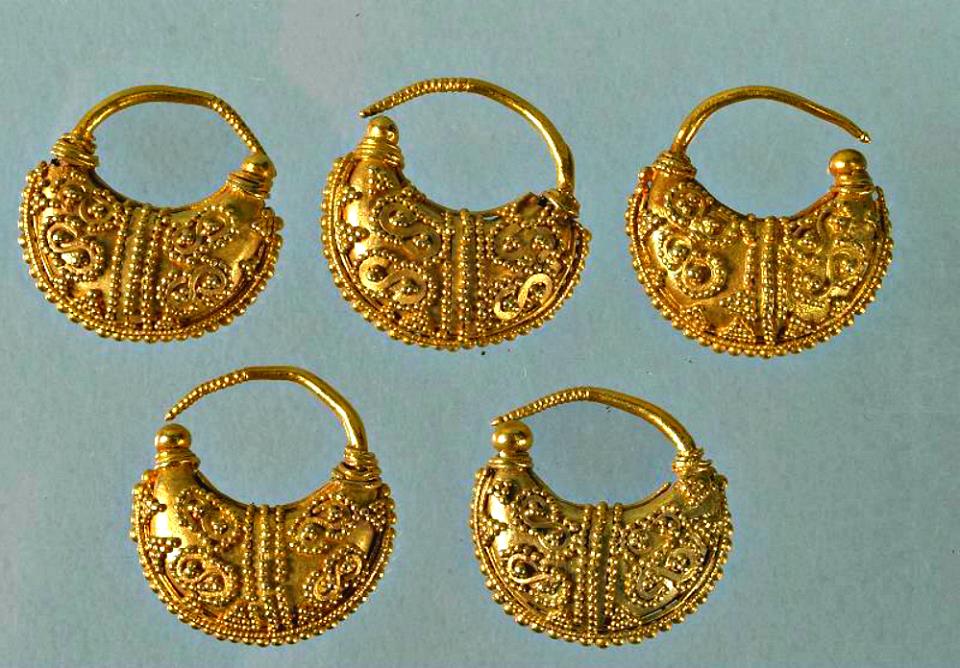
Five golden earrings from the Thracian tombs in cemeteries Duvanlii (5-4 c. BC.) |
![]() |
| Visor |
Dozens of Thracian mounds are spread throughout this Bulgarian region, which archaeologists have called ‘The Valley of the Thracian Kings,’ a reference to the Valley of the Kings near Luxor, which is home to the tombs of Egyptian pharaohs.
As a result of all the archaeological discoveries made at the Valley of the Thracian Kings, Bulgaria has proposed that UNESCO should inscribe the Valley on its World Heritage List.
(Sources: Treasures Fit for the Kings, by Jumana Farouky, TIME magazine, May 29, 2005)
THE TREASURE OF VALCHITRAN
The Valchitran Treasure was discovered in 1924 by two brothers who were working in their vineyard near the village of Valchitran, 22 km southeast of Pleven, Bulgaria. The hoard consists of 13 receptacles, different in form and size and is dated back to 1300 BC, at the time of the Thracians.
Not only the shape of the following vessel itself, but also its intended purpose is very interesting. It is supposed that the Thracian king-priests used the vessels for religious rituals. More specifically rituals related to god Dionysus, worshiped by the ancient Greeks, as well as by the Thracians.
The triple vessel allows three different liquids to be poured in it, for example wine, honey and milk, or only two different liquids to be poured in the side (right and left) almond-shaped pieces, and when they mix thanks to the tubes a certain result becomes visisble, used by the priests to tell the fortune watching the middle piece of the triple vessel.
We can only guess what the purpose of the cymbal-like items was. Were they really cymbals or were used as lids for another vessels? Is their shape related to the sun cult or has another merely practical explanation?
A very interesting fact regarding the small cups is that the master goldsmiths made them in such a way that they would stand in upright position only when filled with liquid.
Probably we will never find out the right answers to these questions but the Valchitran golden treasure gives us the opportunity to touch on antiquity in a unique and mysterious way. The treasure dates back to the end of the Bronze Age, i.e. to the 16th – 12th century BC.
It seems certain that the big, wide and relatively deep gold vessels were used to dilute and mix wine: the ancients used to mix wine, honey and milk in them when they were about to make effusions in honor of Dionysos.
It is now one of the most valuable possessions of the National Archaeological Museum in Sofia.
Not only the shape of the following vessel itself, but also its intended purpose is very interesting. It is supposed that the Thracian king-priests used the vessels for religious rituals. More specifically rituals related to god Dionysus, worshiped by the ancient Greeks, as well as by the Thracians.
The triple vessel allows three different liquids to be poured in it, for example wine, honey and milk, or only two different liquids to be poured in the side (right and left) almond-shaped pieces, and when they mix thanks to the tubes a certain result becomes visisble, used by the priests to tell the fortune watching the middle piece of the triple vessel.
We can only guess what the purpose of the cymbal-like items was. Were they really cymbals or were used as lids for another vessels? Is their shape related to the sun cult or has another merely practical explanation?
A very interesting fact regarding the small cups is that the master goldsmiths made them in such a way that they would stand in upright position only when filled with liquid.
Probably we will never find out the right answers to these questions but the Valchitran golden treasure gives us the opportunity to touch on antiquity in a unique and mysterious way. The treasure dates back to the end of the Bronze Age, i.e. to the 16th – 12th century BC.
It seems certain that the big, wide and relatively deep gold vessels were used to dilute and mix wine: the ancients used to mix wine, honey and milk in them when they were about to make effusions in honor of Dionysos.
It is now one of the most valuable possessions of the National Archaeological Museum in Sofia.
Subscribe to:
Posts (Atom)