The images you'll see as you scroll down to the current text are all part of the story telling in my novel, Realms of Gold:Ritual to Romance.


Bianca Caldwell, pen name, Bianca Fiore, is a writer for an art magazine. In each of her monthly stories she describes an object used in ancient ritual.

Story Merchant Books Reviews The Gift From Fortuny


“Like the intricacy of a Fortuny gown, with its thousands of pleats—each one its own story—this novel takes the reader to the streets and canals of Venice in the late 1940s, affluent Los Angeles in the 1980s and the ancient cities of Granada and Seville. Weaving its way through family sagas, flamenco dance, the sub-culture of Spanish gypsies and lyricism of Italian opera, it brings together a fascinating and disparate collection of characters whose lives are surprisingly and disarmingly intertwined.”
~Pamela Fiori, former editor of Town & Country magazine.


THE 2021 INDEPENDENT PRESS AWARDS ACKNOWLEDGES THE GIFT FROM FORTUNY

The 2021 Independent Press Recognizes The Gift from Fortuny with its Distinguished Favorite Award in the WOMEN’S FICTION category.


To request a review copy or inquire about an author interview, please email atchity@storymerchant.com

⁠

NEWLY RELEASED The Gift from Fortuny


A Tantalizing Search for Truth and Destiny


Like the intricacy of a Fortuny gown, with its thousands of pleats—each one its own story—this novel takes the reader to the streets and canals of Venice in the late 1940s, affluent Los Angeles in the 1980s and the ancient cities of Granada and Seville. Weaving its way through family sagas, flamenco dance, the sub-culture of Spanish gypsies and lyricism of Italian opera, it brings together a fascinating and disparate collection of characters whose lives are surprisingly and disarmingly intertwined.

                                        Pamela Fiori, former editor of Town & Country magazine.  


Praise for The Gift from Fortuny


In the same way Edith Wharton’s The Age of Innocence masterfully evokes a lost Manhattan of Wharton’s youth, Stanfill’s The Gift from Fortuny conjures Los Angeles in 1984 in an equally trenchant, portrait of social ambition.

Into this world that knows “the price of everything and value of nothing” (to quote Mr. Wilde) Terry Stanfill introduces us to a protagonist erupting with yearnings for authenticity, one as poignantly alive as any Chekhovian heroine.

Demetra Killingsworth carries us into an archetypal adventure exploring the very essence and construct of identity.  It's a riveting read.  The author allows one to live languidly within every luscious, layered moment... until she boldly yanks away the veil.  When truth is revealed, it is as translucent as a Venetian sky.

Manfred Flynn Kuhnert


I greatly enjoyed reading The Gift from Fortuny by Terry Stanfill. The author handles her material with skill and authenticity and has given us an enthralling story. Highly recommended.                                                  

Mollie Norwich


I have voyaged over seas, continents and time with author Terry Stanfill through her books, The Blood Remembers and Realms of Gold.  In her newest novel, The Gift from Fortuny, her travels lead the reader from Los Angeles to Andalusia, Spain and to the Venice of Mariano Fortuny y Madrazo, as Stanfill guides us on this remarkable journey in search of knowledge and truth.

Hutton Wilkinson.


In Terry Stanfill’s latest novel, The Gift from Fortuny, a white Delphos gown, designed by the Spaniard, Mariano Fortuny y Madrazo, anchors this scintillating tale which unfolds like the many scenes of an opéra fantastique.  We transcend eras and places in a complex quest to capture the spirit of a young woman’s journey toward self-discovery and realization-- from the social layering of Los Angeles to the Venice of Fortuny and the flamenco of Andalusia.  The author’s prose and her attention to detail first draw us into this novel where we remain until a finale where the strands of the plot are drawn together in a memorable conclusion, one which remains long after the story is told.

Eric T. Haskell Professor Emeritus of French Studies and Interdisciplinary Humanities
Chevalier de l’Ordre des Palmes Académique
Chevalier de l’Ordre des Arts et des 
Lettres
Scripps College Claremont University Consortium, California


Museum at Chatillon Features Realms of Gold!


                                Amis du Musée du Pays Châtillonnais
                                                                                                 Trésor de Vix
No oo1  Lettre aux Amis du Musée  Automne 2014
Fédération Française des Sociétés

d’Amis de Musée (FFSAM)

Notre association est adhérente à la FFSAM à l’instar de quelque 290 autres sociétés d’amis de Musée. En plus de son rôle d’interlocuteur des Pouvoirs Publics, la fédération est un organe de promotion des Sociétés d’Amis et par voie de conséquence des musées, une source de contacts et une occasion d’échanges d’expériences. C’est ainsi qu’un article sur l’AMPC est paru dans le dernier numéro de la revue de la FSAMM. Par ailleurs nous sommes entrain d’établir des relations avec nos collègues de Bourgogne en vue de donner un second souffle au groupement régional (Bourgogne) des sociétés d’amis de musée.
Affaire à suivre.


Un roman autour de la Dame de Vix :

Les royaumes dorés par Terry Stanfill.

La Dame de Vix a inspiré un roman original écrit par une Américaine résidant en Californie, Terry Stanfill.  A l’occasion d’une visite touristique de la région, cette écrivaine eut un véritable coup de cœur pour la Dame de Vix et tout ce qui l’entoure. L’ouvrage
"Les royaumes dorés" en Anglais "Realms of Gold " imagine les circonstances dans lesquelles le vase de Vix est arrivé dans notre Châtillonnais. Naturellement, c’est une fiction : elle met en scènes divers évènements et protagonistes réels ou imaginaires. Les versions françaises et anglaises sont en vente à la boutique du Musée (15€).  


--------------------------------------------------------------------------------------------------

Contacts : Président Robert Fries  Tél :03 80 93 14 42
Secrétariat : 06 36 60 92 78  courriel ampc.tresordevix@gmail.com
Permanence les jeudis de 9h. à 12h. (sur rendez-vous)


The Vix Krater and the Lady of Vix Was she Princess, Priestess, Queen?


The area around the village of Vix, in North east Burgundy is the site of an important prehistoric complex from the Celtic late Hallstatt period.(500 B.), the beginning of the Iron Age. Overlooking this tiny village (200 inhabitants) are traces of an important fortified settlement of an aristocratic, elitist society influenced by Greek and Etruscan culture. 

In 1953 the treasure of the of "the Lady of Vix was discovered, the site dating back to circa 500 BC. The site had never been looted and contained remarkably rich grave offerings, including important jewelry and the magnificent bronze Vix Krater the largest known metal vessel from antiquity. The wealth of this Celtic tribe was derived from farming (with the iron plough) from collecting tolls at the point on the Seine where the river became navigable for transport.They also exchanged tin and copper, salt, furs, and Baltic amber for luxury goods-- fine bronze objects, Greek ceramics, and coral. The cargos were shipped via the Rhone River, south to Massilia (Marseilles) , to finally reach other Mediterranean ports.


The spectacular jewels buried with the :"Lady of Vix," mark her social position. For these Celts gold was a symbol of power. The gold of the Lady (or Princess, or Priestess) of Vix was meant to show those dwelling in the Otherworld that she was important and therefore deserved special treatment. For this reason one could easily speculate that she was a princess or druidess who would display her power to the gods of the Afterlife. The great cauldron, in this case the krater, was the symbol of immortality and abundance to the ancient Celts. There are no records that indicate if druid burials included ornaments of any sort in their burial chambers or even if they were buried at all. However, since they held the highest places in society, it is likely that their burials were elaborate. Although there are few early references to druids in early history, one of the first known mention was in the works of Aristotle, the teacher of Alexander the Great.


Celts - Gold Torque, Detail

Vix, France.
480 BC


This massive torque or diadem was found in the grave of a powerful woman, consisting of 40 individual parts. The two spheres at the ring terminals are held in the paws of lions. The two small winged horses are reminiscent of Pegasus from Greek mythology and bear witness to increased contact with the Mediterranean world. 


Priam's Treasure


Priam’s Treasure is a cache of gold diadems, necklaces, bracelets, rings, and assorted gold, bronze vessels and other artifacts discovered by classical archaeologist Heinrich Schliemann. Schliemann claimed the site to be that of ancient Troy, and assigned the artifacts to the Homeric king Priam.

Gold Ear jewelry, rings and pendants 

Apparently, Schliemann smuggled Priam's Treasure out of Anatolia. The officials were informed when his wife, Sophia, wore the jewels for the public. The Ottoman official assigned to watch the excavation, Amin Effendi, received a prison sentence. The Ottoman government revoked Schliemann's permission to dig and sued him for its share of the gold. Schliemann went on to Mycenae. There, however, the Greek Archaeological Society sent an agent to monitor him.

Later Schliemann traded some treasure to the government of the Ottoman Empire in exchange for permission to dig at Troy again.


Despite Schliemann's myth making, the treasures have nothing to do with King Priam's Troy. They are much older, dating from around 2500 to 2400 B.C., not from the Homeric period, which was 1400 to 1200 B.C. Schliemann said he found Troy by using the Iliad, and for one famous photograph he dressed his wife, Sophia, in a diadem that he claimed had been worn by Helen of Troy.

The "big" diadem in modern exhibition
Selection of gold diadems, necklaces, bracelets, rings, and assorted gold and bronze vessels found by Schliemann at Troy. Pushkin Museum, Moscow.  - See more at: http://realmsofgoldthenovel.blogspot.com/2013/02/gold-of-troy-priams-treasure.html#sthash.zW2MaM76.dpuf
Detail from gold diadem with pendants. Sixty-four small chains, each with links interspaced by gold-leaf lozenges, are suspended from a long, narrow band with 3 holes on each end. The shorter central chains are framed on each side by seven longer chains that converge and terminate in four gold-leaf pendants.


The treasures are actually a thousand years older than Homer's King Priam of Troy, who died about 1200 B.C. They are a stunning collection of gold and silver diadems, bracelets, earrings, pendants, rings, plates, goblets, buttons, cups and perfume jars, which display the extraordinary artistry, technology and trading relationships of an ancient world.


There are 260 individually catalogued items at the Pushkin, but some pieces, like necklaces, have up to 200 beads of varying types. Counting every bead, there are believed to be some 12,000 individual pieces from the 17 separate digs Schliemann made at ancient Troy. Thirteen of those caches are at the Pushkin, with the rest scattered among some 45 other museums around the world.


This pin is part of "Priam's Treasure." Today it is maintained at the Pushkin State Museum of Fine Arts in Moscow. It ended up there when Soviet soldiers who captured Berlin, at the end of World War II, brought it and other recovered Trojan artifacts to Russia.


Museo, Villa Communale, Chieti, Abbruzo, The Capestrano Warrior


I came across this sandstone statue of a warrior chieftain in the museum in Chieti, Abruzzo, South Italy--and had never seen anything like it before. It is of the same period as the Hallstatt Celtic finds of Lady of Vix and the Hochdorf Prince. (6th century B.C.) In the past few decades this image has been used as a symbol the Abruzzo . The Capestrano Warrior is unique, as there are only a few life-sized sculptures from native Italian tribes. Although this is considered the area of Latin tribes (the , there a marked similarity to another sandstone statue found Germany. 


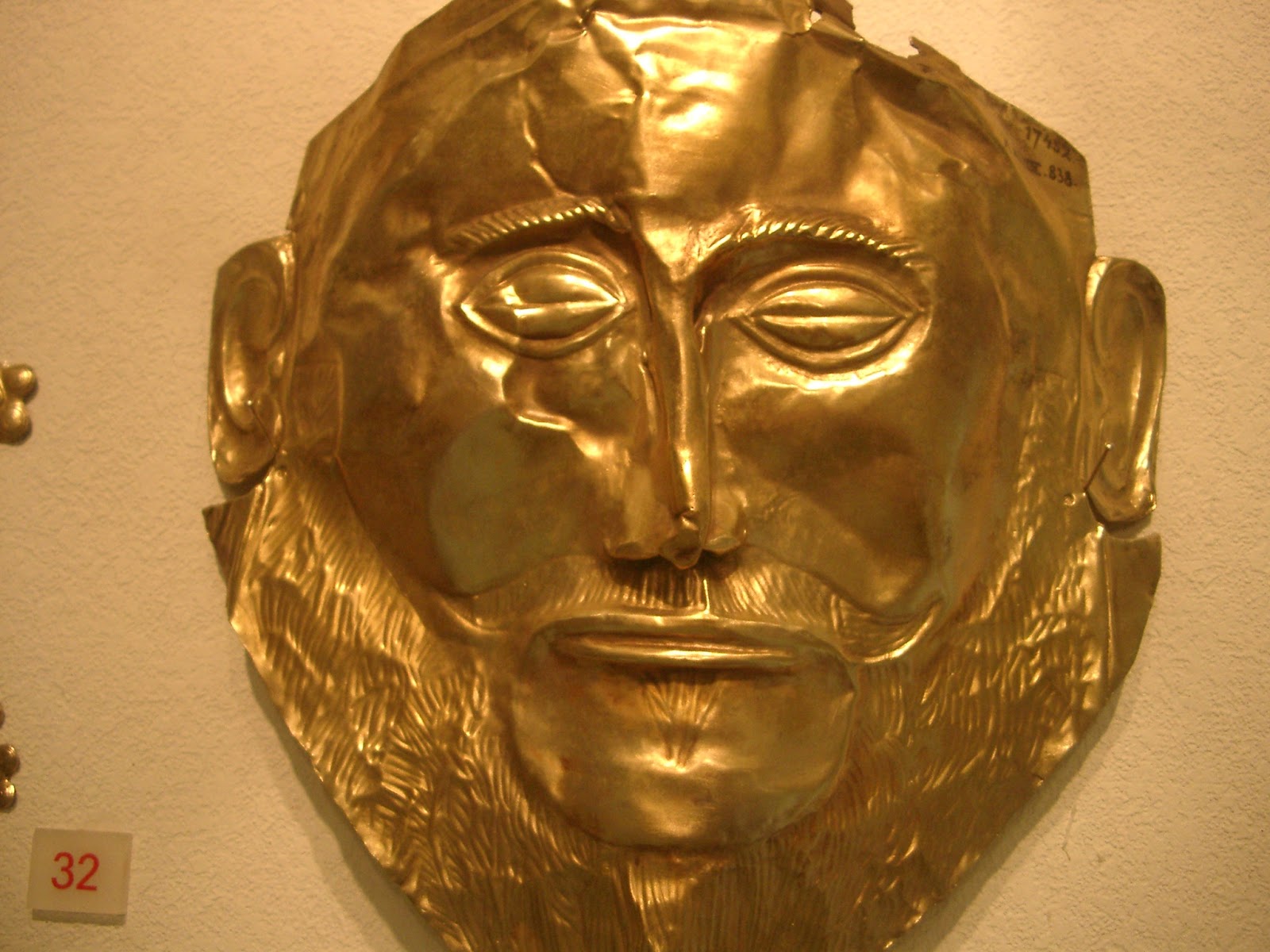
Mask of Agamemnon

The Mask of Agamemnon is an artifact discovered at Mycenae in 1876 by Heinrich Schliemann. 

The Mask of Agamemnon was named by Schliemann after the legendary Greek king of Homer's Iliad. This mask adorned one of the bodies in the shaft graves at Mycenae. Schliemann took this as evidence the Trojan War was a real historical event.

In the latter half of the 20th century and the beginning of the 21st century, the authenticity of the mask has been formally questioned. Archaeology magazine has run a series of articles presenting both sides of the debate

The mask is currently displayed in the National Archaeological Museum in Athens.


LYON, FRANCE—The Local reports that a medieval treasure trove has been found near the Cluny Abbey in eastern France. The excavation team, made up of researchers from the University of Lyon II and France’s National Center for Scientific Research, discovered the cache of twelfth-century coins while looking for the corner of the abbey’s infirmary. Most of the 2,200 silver coins were issued by Cluny Abbey. The 21 gold coins, which had been stored in a canvas bag, originated in the Middle East. Additional gold items include a gold signet ring engraved with the word “Avete,” a Latin greeting, and a folded piece of gold leaf. 

Team member Vincent Borrel said that in their time, the items discovered would have been able to purchase a six-day supply of bread and wine for the abbey. For more, go to “France’s Roman Heritage.”


Read more  


Did the Mayans Fly Airplanes?


Another great mystery that has caused many researchers to scratch their heads, are a group of 1,000-year-old gold pendants which have been unearthed within the Mayan ruins. These pendants measure just 150mm x 125mm in dimension, but they resemble objects that look almost exactly like modern-day airplanes. Some people debate the possibilities that these pendants are actually supposed to be flying insects or animals, but others bring up evidence that seems to prove that this is not the case. Airplanes, you see, require a part called a “vertical stabilizer”, which all of these pendants happen to feature, yet not a single animal on earth possesses. The question that remains is, “Could these aircraft actually fly?”

Read more


Ancient Gold: Greek Gold Diadems


Greek Gold Diadem with Leaves, Carnelian Cabochons and a Horse with Rider, Panticapaeum, 3rd Century BC
A diadem is a type of crown, specifically an ornamental headband worn by monarchs and others as a badge of royalty.

The term originally referred to the embroidered white silk ribbon, ending in a knot and two fringed strips often draped over the shoulders, that surrounded the head of the king to denote his authority. Such ribbons were also used to crown victorious athletes in important sports games in antiquity.

An impressive gold diadem with repousse rosettes and thin sheets applied at the top. Grave III (Grave of the Women), Grave Circle A, Mycenae, 16th.cent BC.

High-ranking or wealthy Greek women often wore elaborate diadems and hairnets of gold and gemstones as part of their jewelry. Due to its protective quality, it also became important in marriage symbolism and was a common motif for women's jewelry of the Hellenistic period, and in royal Macedonian art more generally.

Remarkable gold elliptical funeral diadems, leaves, wheels, cups, earrings, pendants and pins from Shaft Grave III, "Grave of the Women", Grave Circle A, Mycenae. 1600-1500 BC. National Archaeological Museum, Athens.

adorned the head of the buried Mycenean Princes

A diadem is also a jeweled ornament in the shape of a half crown, worn by women and placed over the forehead (in this sense, also called tiara).
In some societies, it may be a wreath worn around the head. The ancient Persians wore a high and erect royal tiara encircled with a diadem. Hera, queen of the Greek gods, wore a golden crown called the diadem.

Two gold diadems from Grave Circle A at Mycenae.

Mycenaean Sheet Gold Diadem Plaque, 2nd ML BC

The shape of this diadem is very similar to the one found by Heinrich Schliemann in the 1876 in Grave Circle A Grave III at the palace of Mycenae except that diadem included seven spear shaped attachments that gave the impression of a sunburst.

By extension, "diadem" can be used generally for an emblem of regal power or dignity. The head regalia worn by Roman Emperors, from the time of Diocletian onwards, is described as a diadem in the original sources.

This highly detailed embossed sheet of gold is a diadem from Mycenae that was crafted around 1600-1500 BC.

It may be a funerary diadem ...  “The headband is made of thin sheet gold and tapers at both ends. These durable objects decorated the hair of the living, but a diadem from Shaft Grave IV must have adorned the head of someone who had already died.”


Treasures of the Sarmatians : Horse Cover

Accomplished horse-breeders and horsemen, Sarmatians were nomadic Indo-European tribes closely related to the Scythians.

The Roman historian Ammianus Marcellinus describes Sarmatian tribesmen as “tall and handsome, their hair inclines to blond; by the ferocity of their gaze they inspire dread. They delight in danger and warfare.”

A fascinating feature of Sarmatian society was the high status accorded to women. Sarmatian warrior queens were renowned in antiquity. Herodotus affirmed that the Sarmatians were descendants of the Amazons and Scythians, whose women “frequently hunted on horseback with their husbands; in war taking the field; and wore the very same dress as the men.” The Sarmatian tradition had it that “no girl should wed till she had killed a man in battle.” In ancient kurgans, sumptuous female burials often included swords and arrowheads together with elegant jewelry inlaid with dazzling gems in the Hellenistic style. Eastern campaigns of Alexander the Great (356-323 BC) spread Greek influences throughout his huge empire and exposed local artisans to new styles. The composite style that emerged is known as Hellenistic.

The Sarmatians were overrun by the invasions of the Goths and Huns in the 3rd and 4th centuries AD. The intense multi-ethnic encounter on the steppe resulted in a complex mix of cultures and artistic styles, evident in the artifacts found in the region.


The horse-cover consists of more than 15,500 golden links. Was found in the city of Azov .

Vratsa Gold Treasure

The most impressive treasures of Ancient Thrace – the Mogilanska Mound treasure.

The 2,500-year-old Mogilanska Mound Treasure, also known as the Vratsa Gold Treasure, was found during the excavations of an Ancient Thracian burial mound in the downtown of Vratsa back in 1965.

a model reconstruction of the princess’s face based on the skull discovered in one of the Mogilanska Mound tombs created by renowned Bulgarian anthropologist Prof. Yordan Yordanov.
In addition to the human and horse skeletons and the chariots discovered in the mound’s three tombs, the archaeologists also found a treasure consisting of a golden laurel wreath, 47 gold appliqués, 2 golden earrings, 4 silver phialae, a silver jug, a rhyton-shaped amphora, and 50 clay figures. The Mogilanska Mound is believed to have been a royal tomb of the ruling dynasty of the Ancient Thracian tribe Triballi which inhabited the region of Northwest Bulgaria more than 2,000 years ago.

The elaborate gold earrings of the Thracian princess
The most valuable artifact from the Vratsa Gold Treasure is the golden laurel wreath which decorated the head of an Ancient Thracian princess.

The golden laurel wreath worn by a Thracian princess from the Triballi tribe which was discovered in the Mogilanska Mound in Bulgaria’s Vratsa


Another one of the most impressive items from the Vratsa Gold Treasure is a gold-plated silver greave (knee-piece) featuring the image of the Mother Goddess.

The forehead of the Mother Goddess depicted on the greave is decorated with a wreath, and her ears – with earrings.

 Interestingly, the other decorations such as the golden earrings and the golden laurel wreath found inside the Mogilanska Mound seem to mimic the decorations depicted in the greave image of the goddess.

The unique craftsmanship of the greave has led the archaeologists to conclude that it was the work of a local Ancient Thracian craftsman.
The Mother Goddess depicted on the greave wears a laurel wreath with gold leaves and golden earrings that are just like the wreath and earrings found inside the tomb of the Thracian princess. Photo: TV grab from BNT 2

This gold-plated silver greave (knee-piece)

Gold Jug

O Golden mask of Teres I, the first ruler of the Odrysian kingdom

The King Teres’ Gold Mask – a Masterpiece of the Thracian Craftmanship


“This is a unique mask and it looks even better than the famous image of king Agamemnon”, said the archeologist prof. Kitov, who discovered it, referring to the mask of Agamemnon, gound by Schliemann in Mycenae.

It is a 2400-year-old life-size mask made of 23.5-carat gold and weighing 672 g (1.48 lb). The mask belonged to king Teres I (450 – 431 BC) and was unearthed in a mound at the Valley of the Thracian kings, Kazanlak region in August, 2004. The sensational archaeological discovery was made by Prof. Georgi Kitov (1943 – 2008) and his team. According to him, “There have been other gold masks discovered, but all of them are made of foil-thin gold. Gold masks with this shape and weight are absolutely unknown”. Besides the king Teres mask, the archaeologists excavated more than 130 precious items including jewelry, weaponry and ritual vessels.

Golden royal ring IV c. BC Gold ring ,dating from the IV c. BC, found in a Thracian king's tomb near Zlatinitsa, Bulgaria The miniature scene of his plate represents the Great Mother Goddess, skid glass of wine the king himself.

The Valley of Thracian Kings Thracian gold shell


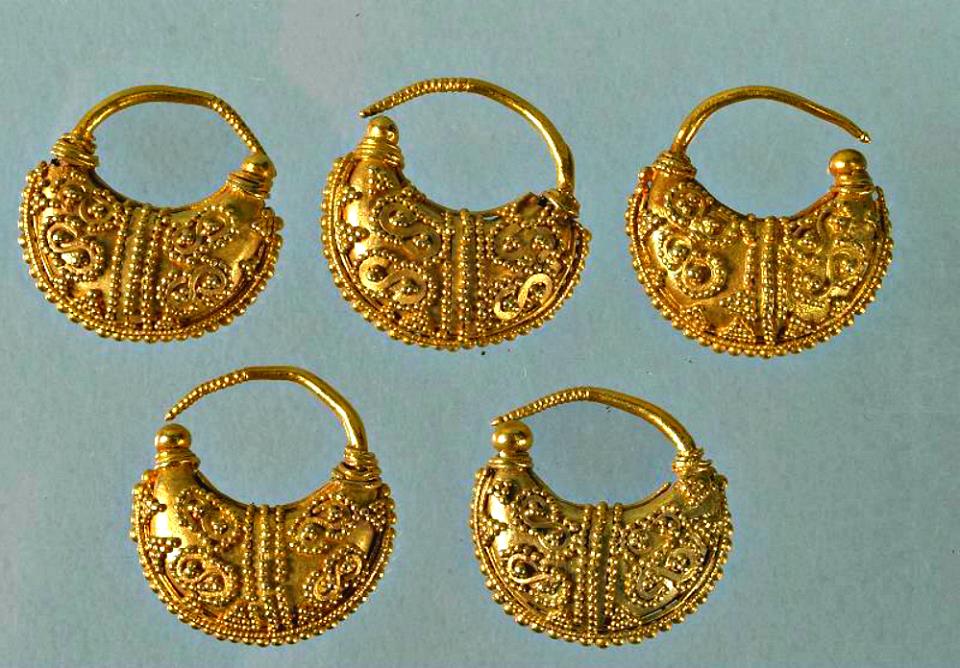
Five golden earrings from the Thracian tombs in cemeteries Duvanlii (5-4 c. BC.)
 In a second mound nearby, called Golyamata Kosmatka (literally meaning “The Big Hairy”), Georgi Kitov chanced upon another treasure trove of 73 gold and silver pieces, including a gold wreath and horse trappings, a visor, gold ornaments of a sword and gold horse harness.


Visor
In addition, the archeologists also found a golden ring, apparently portraying an Olympic rower.


Dozens of Thracian mounds are spread throughout this Bulgarian region, which archaeologists have called ‘The Valley of the Thracian Kings,’ a reference to the Valley of the Kings near Luxor, which is home to the tombs of Egyptian pharaohs.

As a result of all the archaeological discoveries made at the Valley of the Thracian Kings, Bulgaria has proposed that UNESCO should inscribe the Valley on its World Heritage List.

(Sources: Treasures Fit for the Kings, by Jumana Farouky, TIME magazine, May 29, 2005)

THE TREASURE OF VALCHITRAN

The Valchitran Treasure was discovered in 1924 by two brothers who were working in their vineyard near the village of Valchitran, 22 km southeast of Pleven, Bulgaria. The hoard consists of 13 receptacles, different in form and size and is dated back to 1300 BC, at the time of the Thracians.


Not only the shape of the following vessel itself, but also its intended purpose is very interesting. It is supposed that the Thracian king-priests used the vessels for religious rituals. More specifically rituals related to god Dionysus, worshiped by the ancient Greeks, as well as by the Thracians.


The triple vessel allows three different liquids to be poured in it, for example wine, honey and milk, or only two different liquids to be poured in the side (right and left) almond-shaped pieces, and when they mix thanks to the tubes a certain result becomes visisble, used by the priests to tell the fortune watching the middle piece of the triple vessel.

We can only guess what the purpose of the cymbal-like items was. Were they really cymbals or were used as lids for another vessels? Is their shape related to the sun cult or has another merely practical explanation?


A very interesting fact regarding the small cups is that the master goldsmiths made them in such a way that they would stand in upright position only when filled with liquid. 


Probably we will never find out the right answers to these questions but the Valchitran golden treasure gives us the opportunity to touch on antiquity in a unique and mysterious way. The treasure dates back to the end of the Bronze Age, i.e. to the 16th – 12th century BC.


It seems certain that the big, wide and relatively deep gold vessels were used to dilute and mix wine: the ancients used to mix wine, honey and milk in them when they were about to make effusions in honor of Dionysos.

 It is now one of the most valuable possessions of the National Archaeological Museum in Sofia.