The images you'll see as you scroll down to the current text are all part of the story telling in my novel, Realms of Gold:Ritual to Romance.


Bianca Caldwell, pen name, Bianca Fiore, is a writer for an art magazine. In each of her monthly stories she describes an object used in ancient ritual.

Showing posts with label Photo Gallery. Show all posts

Museo, Villa Communale, Chieti, Abbruzo, The Capestrano Warrior


I came across this sandstone statue of a warrior chieftain in the museum in Chieti, Abruzzo, South Italy--and had never seen anything like it before. It is of the same period as the Hallstatt Celtic finds of Lady of Vix and the Hochdorf Prince. (6th century B.C.) In the past few decades this image has been used as a symbol the Abruzzo . The Capestrano Warrior is unique, as there are only a few life-sized sculptures from native Italian tribes. Although this is considered the area of Latin tribes (the , there a marked similarity to another sandstone statue found Germany. 


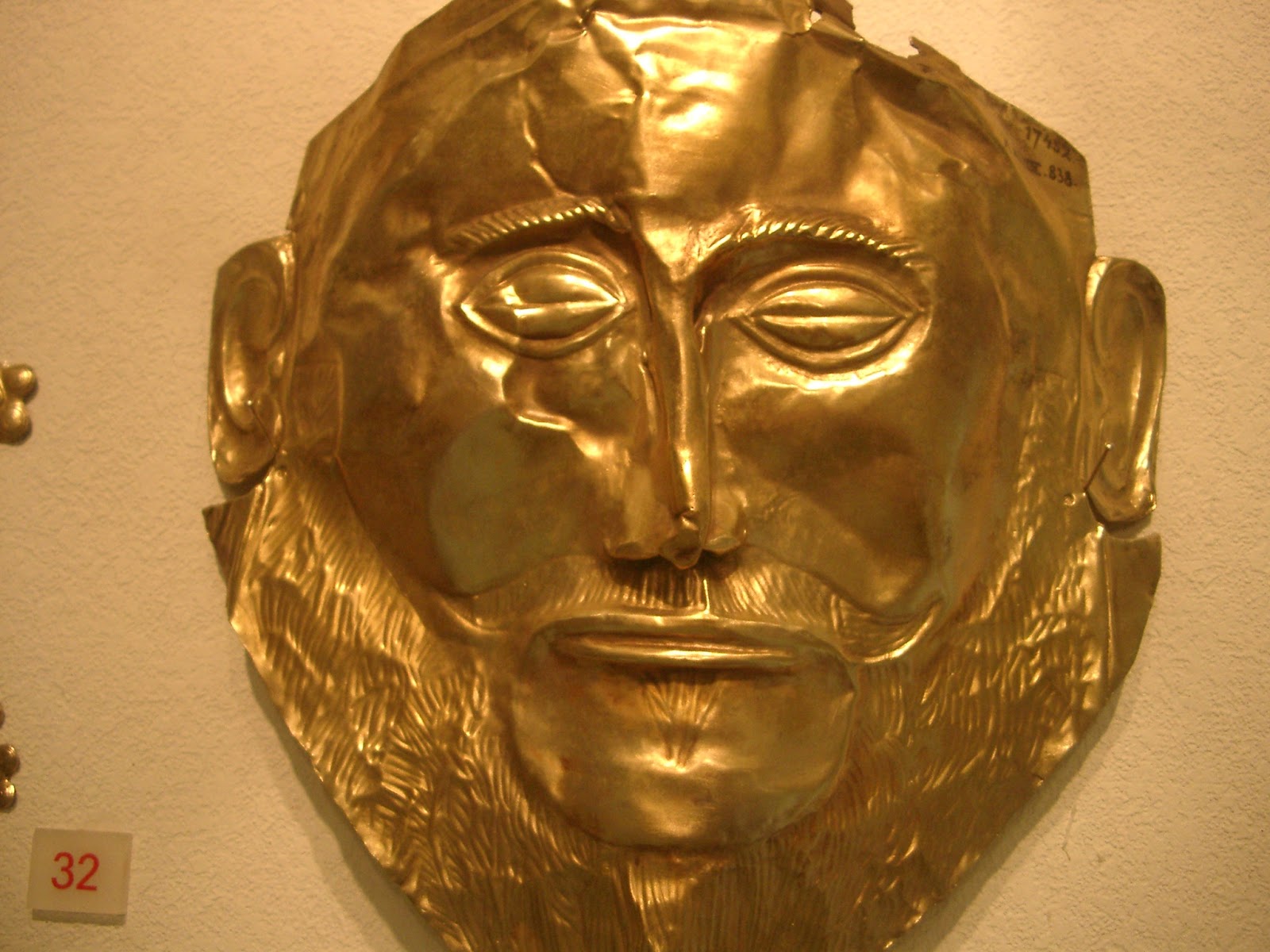
Mask of Agamemnon

The Mask of Agamemnon is an artifact discovered at Mycenae in 1876 by Heinrich Schliemann. 

The Mask of Agamemnon was named by Schliemann after the legendary Greek king of Homer's Iliad. This mask adorned one of the bodies in the shaft graves at Mycenae. Schliemann took this as evidence the Trojan War was a real historical event.

In the latter half of the 20th century and the beginning of the 21st century, the authenticity of the mask has been formally questioned. Archaeology magazine has run a series of articles presenting both sides of the debate

The mask is currently displayed in the National Archaeological Museum in Athens.


Treasures of the Sarmatians : Horse Cover

Accomplished horse-breeders and horsemen, Sarmatians were nomadic Indo-European tribes closely related to the Scythians.

The Roman historian Ammianus Marcellinus describes Sarmatian tribesmen as “tall and handsome, their hair inclines to blond; by the ferocity of their gaze they inspire dread. They delight in danger and warfare.”

A fascinating feature of Sarmatian society was the high status accorded to women. Sarmatian warrior queens were renowned in antiquity. Herodotus affirmed that the Sarmatians were descendants of the Amazons and Scythians, whose women “frequently hunted on horseback with their husbands; in war taking the field; and wore the very same dress as the men.” The Sarmatian tradition had it that “no girl should wed till she had killed a man in battle.” In ancient kurgans, sumptuous female burials often included swords and arrowheads together with elegant jewelry inlaid with dazzling gems in the Hellenistic style. Eastern campaigns of Alexander the Great (356-323 BC) spread Greek influences throughout his huge empire and exposed local artisans to new styles. The composite style that emerged is known as Hellenistic.

The Sarmatians were overrun by the invasions of the Goths and Huns in the 3rd and 4th centuries AD. The intense multi-ethnic encounter on the steppe resulted in a complex mix of cultures and artistic styles, evident in the artifacts found in the region.


The horse-cover consists of more than 15,500 golden links. Was found in the city of Azov .

Treasure of Villena


An  inventory of the contents of the jar revealed an impressive haul: sixty eight separate pieces including five flagons, twenty-eight bracelets and two sword handles. The total weight of the gold treasure was over twenty-two pounds, the heaviest yet unearthed. One bracelet alone weighed more than a pound. The jar had been so skillfully packed that not an inch of space was wasted. This fact, plus the great depth suggests that it was a king’s treasure which had been buried for safekeeping. Evidence of fire in the soil around the spot indicated that a building once stood there, perhaps a royal palace which was set ablaze in the course of a battle

Sarmatian Zoomorphic Art: Vessel

This round Sarmatian vessel, with its upper edge turned slightly outwards, has a handle in the form of a young elk. The form of the vessel is identical to that of the hollow vessels typical of nomadic culture. The elk's body is well modelled; the eyes, and muscles of its back, shoulders and hind quarters are emphasized by inlays of turquoise, coral and glass. The vessel and handle were cast separately and then soldered together. 

 Zoomorphic handles were typical of Sarmatian culture. Animals were positioned with their heads looking towards the rim in order to protect the contents. The Sarmatians believed that animal images formed a protection against evil spirits. 


Khokhlach Burial Mound, near Novocherkassk
1st century AD
Gold, turquoise, coral


Sarmatian TREASURES: ANIMAL MOTIFS

The Animal Style of the Hellenistic period differs from the earlier decorative approach developed by Scythian artisans whose animal designs resemble heraldic representations. As Sarmatian tribes became the masters of the steppe, the artists began to focus on scenes of struggle rather than on individual animals, bringing into their creations the dynamism and the tension of a mortal combat between predators and their victims.


Vessels with animal-shaped handles were known to many ancient cultures from China to Persia. Appearing on the artifacts of the Sarmatian period, animal-shaped handles may be interpreted as a sign of the Iranian influence. Moreover, zoomorphic handles were typical of Sarmatian culture.

Treasures of the Sarmatians: Hinged Neck Ring in the Animal Motif

Sarmatian Golden Neck Circlet

Studded with turquoise, coral and glass from the Chochlatch kurgan near Novocherkask. Katalog Nr. 88 Â


Sarmatian-1st-century-ad


© Staatliche Eremitage St. Petersburg Die Bildrechte an den Aufnahmen werden ausschließlich und einmalig zur Publikation im Zusammenhang mit der Berichterstattung für die Ausstellung â€Å¾Das Gold der Steppe. Fürstenschätze jenseits des Alexanderreichsâ€Å“ der Reiss-Engelhorn-Museen (26. November 2009 - 25. Mai 2010) kostenfrei für die Presse erteilt. 

Treasures of the Sarmatians: Bracelets


Bracelets, 4th-6th Centuries A.D.
Gold, jade, garnet, topaz, enamel: forging, engraving, granulation, encrustation

Signing Realms of Gold in Exeter Chapel


The Chapel, Exeter College, Oxford--tapestry is by  Burne-Jones-William Morris , both had been students at Exeter College