The images you'll see as you scroll down to the current text are all part of the story telling in my novel, Realms of Gold:Ritual to Romance.


Bianca Caldwell, pen name, Bianca Fiore, is a writer for an art magazine. In each of her monthly stories she describes an object used in ancient ritual.

Showing posts with label Regolini-Galassi Tomb. Show all posts

The Regolini-Galassi Tomb - Etruscan Gold


In 1836 the archaeologists Archbishop Alessandro Regolini and General Vincenzo Galassi uncovered an intact tomb of a high-ranking Etruscan womanIn the western necropolis of Cerveteri, in the village of Sorbo. Following the discovery of the tomb’s spectacular treasures, which included hundreds of pieces of jewelry, all things Etruscan became fashionable in Europe. Italian goldsmiths, masters in the techniques of granulation and filigree work, developed neo-Etruscan style jewelry.

Golden disc fibula from the Regolini-Galassi tomb, 7th century BC (photo: Vatican Museum)

This grand gold fibula adorned with five tiny lions depicted striding across its surface, and a large 25 cm long plaque, decorated with depictions of animals of Eastern origin was one of the many gold items found in the tomb.The fibula has been acclaimed as masterful in technique.


Together with the fibula, this breastplate was worn by the deceased woman in the end cell who thus appeared to the amazed discoverers as literally covered in gold.

It consists of a single laminated sheet shaped and decorated with embossed work with a series of 16 different punches. The decoration is divided into strips that follow the margins, going around the central emblem, and are characterized by the serial repetition of the same motif. Starting from the outer strip we see the following series of illustrations: broken line; grazing male ibex; winged lion; chimera with two protomes; pegasus; rear view of lion; grazing deer; woman in a tunic with a palm frond; winged lion, winged woman, lion. In the central emblem: semicircular decorations with overlapping spirals and stems, winged lions, women with palms and four male figures, each holding the front paws of a pair of rampant lions.


Four of the eighteen fibulae from the Regolini-Galassi Tomb tomb that were probably used to fasten the shroud.
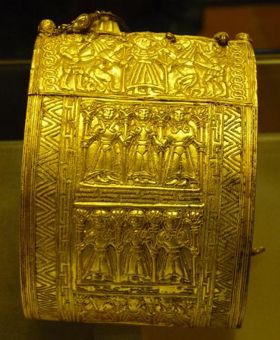


The arm bands came from the Regolini-Galassi tomb at Cerveteri. They were manufactured in the middle of the 7th century B.C., in the local area; each bracelet is made of a rectangular band of gold.

The central part of each bracelet is decorated with repeated scenes of three standing female figures, who hold a palm in each hand.

At each end, the bands are decorated with a more complex scene: two palms surround a woman who stands between two lions, each stretching out a front paw and leaning the other on her shoulder.


Embossed and engraved gilt silver cup, from Regolini Galassi tomb at Cerveteri (Rome)

Gold Earring Stud 530–480 BC

Etruscan Gold: Regolini-Galassi Tomb - Arm Bands

Gold Arm Bands


The arm bands came from the Regolini-Galassi tomb at Cerveteri. They were manufactured in the middle of the 7th century B.C., in the local area; each bracelet is made of a rectangular band of gold and has a length of 26 cm, a width of 6.9 cm and a diameter of 10 cm.

The central part of each bracelet is decorated with repeated scenes of three standing female figures, who hold a palm in each hand.

At each end, the bands are decorated with a more complex scene: two palms surround a woman who stands between two lions, each stretching out a front paw and leaning the other on her shoulder.

Etruscan Gold: Regolini-Galassi Tomb - Fibulas


Four of the eighteen fibulae from the Regolini-Galassi Tomb tomb that were probably used to fasten the shroud.


Etruscan Gold: Regolini-Galassi Tomb - Griffin Detail

Griffins

On many of the items found there are depictions of griffins on these objects.  Griffins were a popular theme in Etruscan art in the Orientalising Period in which this tomb has been built, but they are depicted in a very distinct way, with two long curls in the neck, which would indicate that there is an interesting story behind.


 Detail of the bottom part of the golden fibula showing griffins


 Detail of the golden breast plate showing griffins

Etruscan Gold: Woman, Buried in the Regolini-Galassi Tomb.

For the first time, a visualization is shown of the woman, buried in the Regolini-Galassi tombe.  Visualization of the objects to the golden pectoral and the golden disc fibula below.

pectoral
View on the deceased princess (image: CNR-ITABC)

A lot of new research was done to concerning the position of the golden disc fibula.  Some research showed that such a fibula was placed on the abdomen. (see image below).

fibula
View on the disc fibula (image: CNR-ITABC)


Etruscan Gold: Regolini-Galassi Tomb - Gold Pectoral

Together with the fibula, this breastplate was worn by the deceased woman in the end cell who thus appeared to the amazed discoverers as literally covered in gold. 

It consists of a single laminated sheet shaped and decorated with embossed work with a series of 16 different punches. The decoration is divided into strips that follow the margins, going around the central emblem, and are characterized by the serial repetition of the same motif. Starting from the outer strip we see the following series of illustrations: broken line; grazing male ibex; winged lion; chimera with two protomes; pegasus; rear view of lion; grazing deer; woman in a tunic with a palm frond; winged lion, winged woman, lion. In the central emblem: semicircular decorations with overlapping spirals and stems, winged lions, women with palms and four male figures, each holding the front paws of a pair of rampant lions.

Cerveteri, Regolini Galassi Tomb
mid 7th cent. BC
gold
max width cm 38.1; max height cm 42.0


Etruscan Gold: The Regolini-Galassi Tomb

Grand Fibula 

In 1836 the archaeologists Archbishop Alessandro Regolini and General Vincenzo Galassi uncovered an intact tomb of a high-ranking Etruscan womanIn the western necropolis of Cerveteri, in the village of Sorbo. Following the discovery of the tomb’s spectacular treasures, which included hundreds of pieces of jewelry, all things Etruscan became fashionable in Europe. Italian goldsmiths, masters in the techniques of granulation and filigree work, developed neo-Etruscan style jewelry.

This grand gold fibula adorned with five tiny lions depicted striding across its surface, and a large 25 cm long plaque, decorated with depictions of animals of Eastern origin was one of the many gold items found in the tomb.The fibula has been acclaimed as masterful in technique.

Disc fibula in gold, From Regolini-Galassi tomb in Cerveteri (Rome) .650 BC


Although the limited excavation data indicate an origin from the fibula near the head of the deceased, it is plausible to imagine its use as a stop on the shoulder of her dress. The type and technique typically attach the object to the local manufacturing Etruscan.

The piece is kept at the Gregorian Etruscan Museum of the Vatican.