Vix, France.
480 BC
This massive torque or diadem was found in the grave of a powerful woman, consisting of 40 individual parts. The two spheres at the ring terminals are held in the paws of lions. The two small winged horses are reminiscent of Pegasus from Greek mythology and bear witness to increased contact with the Mediterranean world.
The images you'll see as you scroll down to the current text are all part of the story telling in my novel, Realms of Gold:Ritual to Romance.
Bianca Caldwell, pen name, Bianca Fiore, is a writer for an art magazine. In each of her monthly stories she describes an object used in ancient ritual.
Priam's Treasure

Priam’s Treasure is a cache of gold diadems, necklaces, bracelets, rings, and assorted gold, bronze vessels and other artifacts discovered by classical archaeologist Heinrich Schliemann. Schliemann claimed the site to be that of ancient Troy, and assigned the artifacts to the Homeric king Priam.
![]() |
| Gold Ear jewelry, rings and pendants |
Apparently, Schliemann smuggled Priam's Treasure out of Anatolia. The officials were informed when his wife, Sophia, wore the jewels for the public. The Ottoman official assigned to watch the excavation, Amin Effendi, received a prison sentence. The Ottoman government revoked Schliemann's permission to dig and sued him for its share of the gold. Schliemann went on to Mycenae. There, however, the Greek Archaeological Society sent an agent to monitor him.
Later Schliemann traded some treasure to the government of the Ottoman Empire in exchange for permission to dig at Troy again.
Despite Schliemann's myth making, the treasures have nothing to do with King Priam's Troy. They are much older, dating from around 2500 to 2400 B.C., not from the Homeric period, which was 1400 to 1200 B.C. Schliemann said he found Troy by using the Iliad, and for one famous photograph he dressed his wife, Sophia, in a diadem that he claimed had been worn by Helen of Troy.
| The "big" diadem in modern exhibition |
Selection
of gold diadems, necklaces, bracelets, rings, and assorted gold and
bronze vessels found by Schliemann at Troy. Pushkin Museum, Moscow. - See more at: http://realmsofgoldthenovel.blogspot.com/2013/02/gold-of-troy-priams-treasure.html#sthash.zW2MaM76.dpuf
Detail from gold diadem with pendants. Sixty-four small chains, each with links interspaced by gold-leaf lozenges, are suspended from a long, narrow band with 3 holes on each end. The shorter central chains are framed on each side by seven longer chains that converge and terminate in four gold-leaf pendants.The treasures are actually a thousand years older than Homer's King Priam of Troy, who died about 1200 B.C. They are a stunning collection of gold and silver diadems, bracelets, earrings, pendants, rings, plates, goblets, buttons, cups and perfume jars, which display the extraordinary artistry, technology and trading relationships of an ancient world.
There are 260 individually catalogued items at the Pushkin, but some pieces, like necklaces, have up to 200 beads of varying types. Counting every bead, there are believed to be some 12,000 individual pieces from the 17 separate digs Schliemann made at ancient Troy. Thirteen of those caches are at the Pushkin, with the rest scattered among some 45 other museums around the world.
This pin is part of "Priam's Treasure." Today it is maintained at the Pushkin State Museum of Fine Arts in Moscow. It ended up there when Soviet soldiers who captured Berlin, at the end of World War II, brought it and other recovered Trojan artifacts to Russia.
Museo, Villa Communale, Chieti, Abbruzo, The Capestrano Warrior
I came across this sandstone statue of a warrior chieftain in the museum in Chieti, Abruzzo, South Italy--and had never seen anything like it before. It is of the same period as the Hallstatt Celtic finds of Lady of Vix and the Hochdorf Prince. (6th century B.C.) In the past few decades this image has been used as a symbol the Abruzzo . The Capestrano Warrior is unique, as there are only a few life-sized sculptures from native Italian tribes. Although this is considered the area of Latin tribes (the , there a marked similarity to another sandstone statue found Germany.
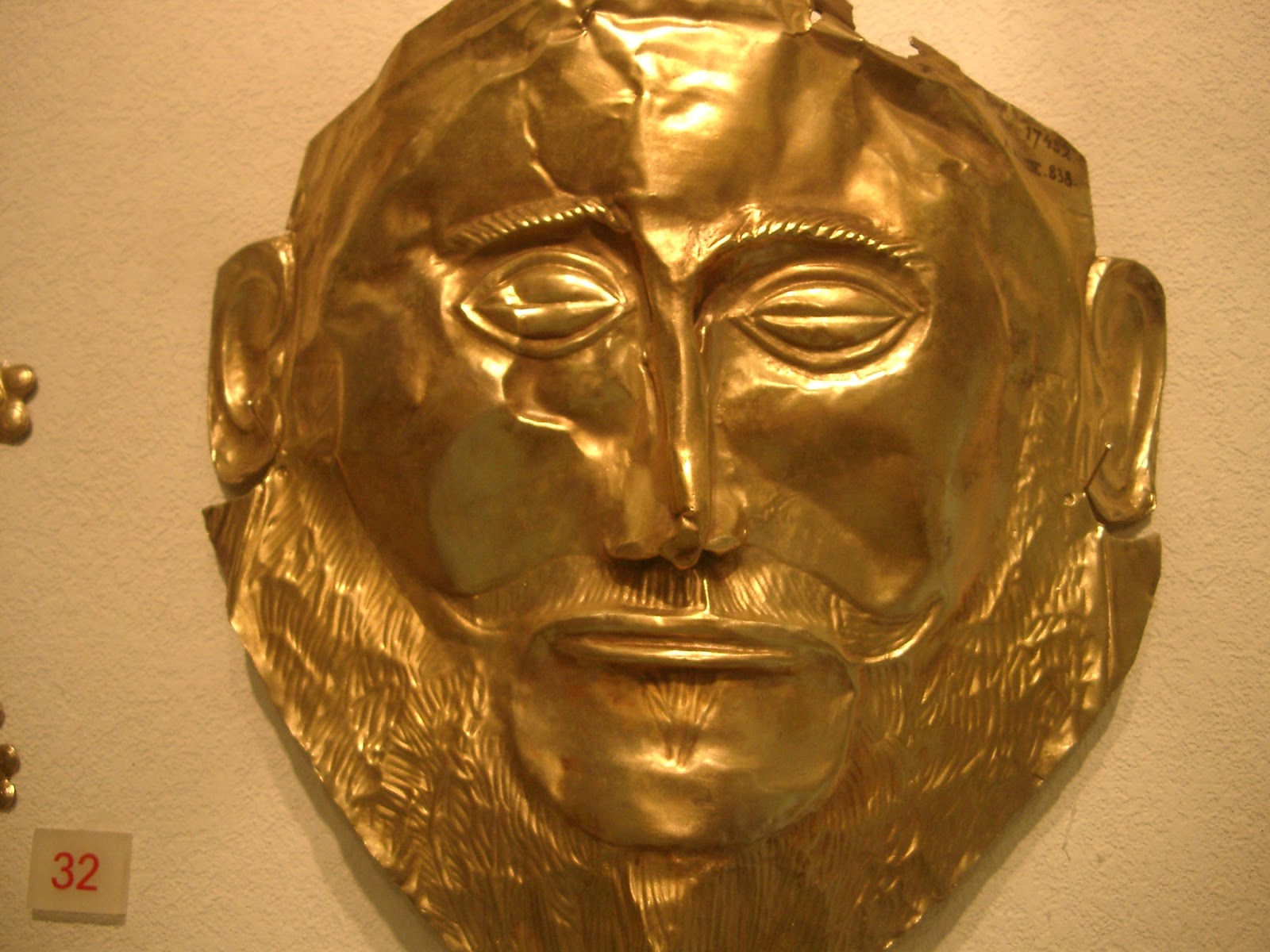
Mask of Agamemnon
The Mask of Agamemnon is an artifact discovered at Mycenae in 1876 by Heinrich Schliemann.
The Mask of Agamemnon was named by Schliemann after the legendary Greek king of Homer's Iliad. This mask adorned one of the bodies in the shaft graves at Mycenae. Schliemann took this as evidence the Trojan War was a real historical event.
In the latter half of the 20th century and the beginning of the 21st century, the authenticity of the mask has been formally questioned. Archaeology magazine has run a series of articles presenting both sides of the debate
The mask is currently displayed in the National Archaeological Museum in Athens.
LYON, FRANCE—The Local reports that a medieval treasure trove has been found near the Cluny Abbey in eastern France. The excavation team, made up of researchers from the University of Lyon II and France’s National Center for Scientific Research, discovered the cache of twelfth-century coins while looking for the corner of the abbey’s infirmary. Most of the 2,200 silver coins were issued by Cluny Abbey. The 21 gold coins, which had been stored in a canvas bag, originated in the Middle East. Additional gold items include a gold signet ring engraved with the word “Avete,” a Latin greeting, and a folded piece of gold leaf.
Team member Vincent Borrel said that in their time, the items discovered would have been able to purchase a six-day supply of bread and wine for the abbey. For more, go to “France’s Roman Heritage.”
Read more
Did the Mayans Fly Airplanes?
Another great mystery that has caused many researchers to scratch their heads, are a group of 1,000-year-old gold pendants which have been unearthed within the Mayan ruins. These pendants measure just 150mm x 125mm in dimension, but they resemble objects that look almost exactly like modern-day airplanes. Some people debate the possibilities that these pendants are actually supposed to be flying insects or animals, but others bring up evidence that seems to prove that this is not the case. Airplanes, you see, require a part called a “vertical stabilizer”, which all of these pendants happen to feature, yet not a single animal on earth possesses. The question that remains is, “Could these aircraft actually fly?”
Read more
Ancient Gold: Greek Gold Diadems
![]() |
| Greek Gold Diadem with Leaves, Carnelian Cabochons and a Horse with Rider, Panticapaeum, 3rd Century BC |
The term originally referred to the embroidered white silk ribbon, ending in a knot and two fringed strips often draped over the shoulders, that surrounded the head of the king to denote his authority. Such ribbons were also used to crown victorious athletes in important sports games in antiquity.
| An impressive gold diadem with repousse rosettes and thin sheets applied at the top. Grave III (Grave of the Women), Grave Circle A, Mycenae, 16th.cent BC. |
High-ranking or wealthy Greek women often wore elaborate diadems and hairnets of gold and gemstones as part of their jewelry. Due to its protective quality, it also became important in marriage symbolism and was a common motif for women's jewelry of the Hellenistic period, and in royal Macedonian art more generally.
![]() |
| adorned the head of the buried Mycenean Princes |
A diadem is also a jeweled ornament in the shape of a half crown, worn by women and placed over the forehead (in this sense, also called tiara).
In some societies, it may be a wreath worn around the head. The ancient Persians wore a high and erect royal tiara encircled with a diadem. Hera, queen of the Greek gods, wore a golden crown called the diadem.
![]() |
| Two gold diadems from Grave Circle A at Mycenae. |
By extension, "diadem" can be used generally for an emblem of regal power or dignity. The head regalia worn by Roman Emperors, from the time of Diocletian onwards, is described as a diadem in the original sources.
Subscribe to:
Posts (Atom)