The images you'll see as you scroll down to the current text are all part of the story telling in my novel, Realms of Gold:Ritual to Romance.


Bianca Caldwell, pen name, Bianca Fiore, is a writer for an art magazine. In each of her monthly stories she describes an object used in ancient ritual.

Showing posts with label Mixoparthenos. Show all posts

The Mixoparthenos - Siren

 
"Siren, Bronze, Italian (Rome), ca. 1570-90.  
The Metropolitan Museum of Art
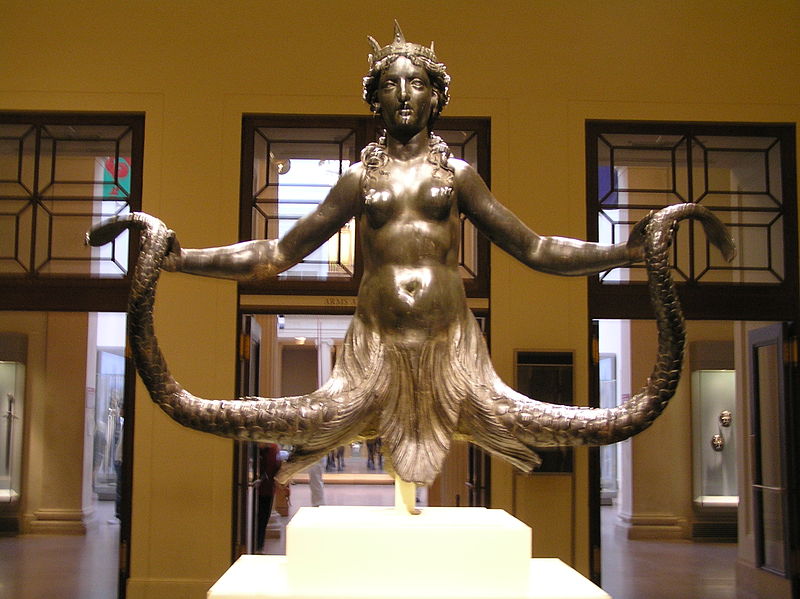


 Fichier:Mixoparthenos.jpg

 
The Mixoparthenos (Greek: Μιξοπάρθενος) was a Greek mythological figure,  traditionally hailing from the Black Sea region where her image is seen frequentl. The name means "half-maiden" .


The form of the Mixoparthenos is distinctive - above the waist, a beautiful woman, but covered with scales from waist down, ending in a double snake-tail. Some versions have the Mixoparthenos ending in a double fish-tail. Herodotus's Histories (4.9.2), Heracles marvels at a Mixoparthenos when he meets one, and mates with her, producing three sons, the youngest of which eventually became the founder of the Scythian nation. 
 
The Starbucks logo depicts a Mixoparthenos, of the double fish-tailed variety.

The Mixoparthenos


The mixoparthenos is a mythical creature whose image, to this day, is seen in the coastal areas around the Greek colonies of the Black Sea, where wheat has been a major crop since ancient times.  

Herodotus writes that the horses of Heracles was stolen by the mixoparthenos, who promised to return them if he mated with her.  How could Hercules resist!  From their union came three sons, the youngest, Scythes, the only son who could bend the bow of Hercules.  He became king of the people who would be called Scythian. There were many Scythian wheat growers around the Black Sea. 


Limestone sculpture, 1st-2nc. AD, from the Black Sea.”
From the land of the wheat growing Scythians along the Black Sea, Olbia.