The images you'll see as you scroll down to the current text are all part of the story telling in my novel, Realms of Gold:Ritual to Romance.


Bianca Caldwell, pen name, Bianca Fiore, is a writer for an art magazine. In each of her monthly stories she describes an object used in ancient ritual.

Praise For Realms of Gold ...

Terry Stanfill's intriguing odyssey is both an entertainment and an education in Arthurian legend and antiquities. She delicately weaves the fictional narrative together with historical facts and keeps the plot edging toward the resolution. "Realms of Gold" has suspense, mythology and romance set against the backdrops of Italy and France. I was fascinated throughout. What a pleasure to read a 21st century novel that is a page turnover without violence, sadism, evil or dysfunctional characters. 

Pamela Fiori  (Author and long time editor  in Chief of Town & Country Magazine)

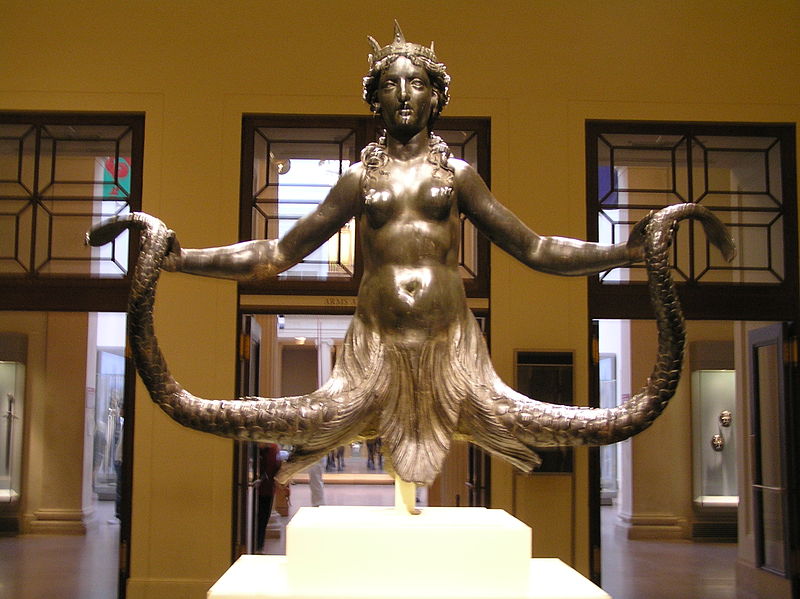
The Mixoparthenos - Siren

 
"Siren, Bronze, Italian (Rome), ca. 1570-90.  
The Metropolitan Museum of Art


 Fichier:Mixoparthenos.jpg

 
The Mixoparthenos (Greek: Μιξοπάρθενος) was a Greek mythological figure,  traditionally hailing from the Black Sea region where her image is seen frequentl. The name means "half-maiden" .


The form of the Mixoparthenos is distinctive - above the waist, a beautiful woman, but covered with scales from waist down, ending in a double snake-tail. Some versions have the Mixoparthenos ending in a double fish-tail. Herodotus's Histories (4.9.2), Heracles marvels at a Mixoparthenos when he meets one, and mates with her, producing three sons, the youngest of which eventually became the founder of the Scythian nation. 
 
The Starbucks logo depicts a Mixoparthenos, of the double fish-tailed variety.

The Mixoparthenos


The mixoparthenos is a mythical creature whose image, to this day, is seen in the coastal areas around the Greek colonies of the Black Sea, where wheat has been a major crop since ancient times.  

Herodotus writes that the horses of Heracles was stolen by the mixoparthenos, who promised to return them if he mated with her.  How could Hercules resist!  From their union came three sons, the youngest, Scythes, the only son who could bend the bow of Hercules.  He became king of the people who would be called Scythian. There were many Scythian wheat growers around the Black Sea. 


Limestone sculpture, 1st-2nc. AD, from the Black Sea.”
From the land of the wheat growing Scythians along the Black Sea, Olbia.

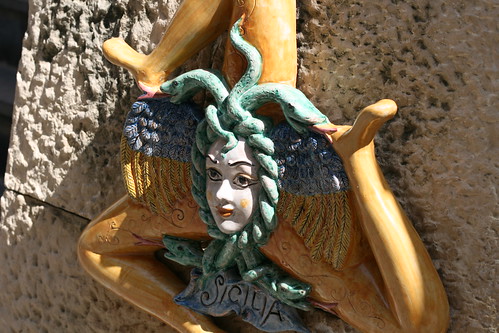
Triskeltion

"In Sicily, the first inhabitants mentioned in history are the tribes of the Sicani (Greek Sikanoi) and the Sicels (Greek Sikeloi), who have given Sicily its more familiar modern "The symbol dates back to when Sicily was part of Magna Graecia, the colonial extension of Greece beyond the Aegean. Pliny the Elder attributes the origin of the triskelion of Sicily to the triangular form of the island, the ancient Trinacria. The triskelion was revived, as an emblem for the new Napoleonic Kingdom of the Two Sicilies, by Joachim Murat in 1808.


 The center head, complete with snakes for hair, is that of Medusa.

In an earlier blog for Sicilia Bedda. sung by Giuseppe di Stefano.
explains the consonant shift from D to L  to change Medus to Melusina